
10 Engaging Math Games for Middle Schoolers That Aren’t Cringe or Boring
Middle schoolers despise babyish math apps. Discover 10 sleek, esports-style free online math games covering pre-algebra, negative integers, PEMDAS, and 2-player split-screen battles that 6th, 7th, and 8th graders actually love playing.
Ask any 7th grader what they think of most educational math websites, and they will give you a single devastating review: "It’s so cringe."
By the time students reach ages 11 to 14 (Grades 6 through 8), their cognitive psychology undergoes a profound adolescent shift. They no longer want smiling cartoon teddy bears, kindergarten sing-alongs, or slow-moving animations that treat them like toddlers. Yet traditional middle school curriculum resources swing to the opposite extreme: dry, black-and-white 50-problem worksheets that induce instant eye-rolls and smartphone sneaking.
Middle schoolers crave agency, competitive stakes, sleek aesthetics, and peer camaraderie. When math concepts like negative integer operations, order of operations (PEMDAS), and multi-step algebraic equations are gamified with esports-style pacing, students don't just tolerate math—they enthusiastically beg for "one more match!"
The Psychology of Adolescent Engagement: Why Traditional Drills Fail
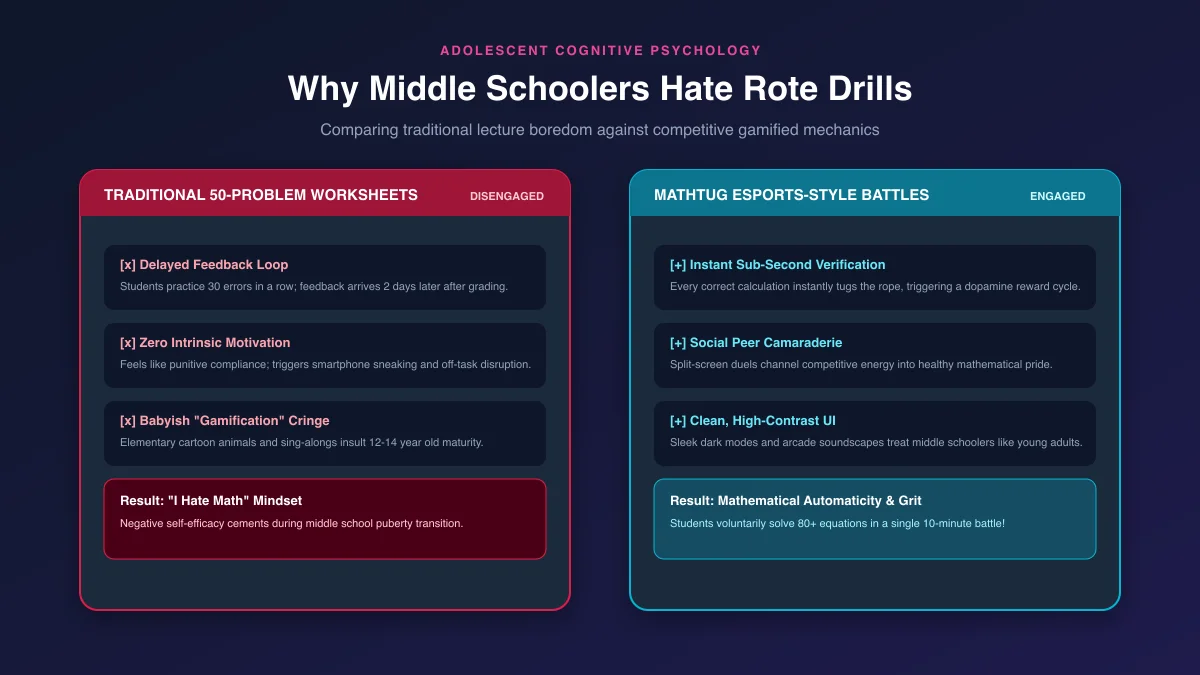
During the transition from elementary to middle school, the brain’s prefrontal cortex and dopamine reward pathways undergo massive synaptic reorganization. Understanding these psychological drivers explains why gamified mechanics consistently outperform rote drills:
-
1. Sub-Second Feedback Loops vs. 48-Hour Grading Lag
When a student completes a 30-problem paper worksheet on integer addition, they might reinforce an erroneous rule (like believing
-5 + (-8) = +13) across thirty consecutive problems. They don't discover their mistake until the teacher hands back the graded paper two days later. In an interactive game like Tug-of-War, feedback is sub-second: a miscalculation instantly tugs the rope away, forcing immediate self-correction. -
2. Social Competition and Peer Accountability
Middle schoolers are hyper-attuned to social dynamics. Solo drill apps isolate students in boring digital bubbles. In contrast, 2-player split-screen battles channel natural peer rivalry into focused academic grit: students cheer, strategize, and work through complex multi-digit calculations at double their ordinary speed.
-
3. Mature, Uncluttered Visual Design
Middle schoolers respect tools that look modern. MathTug's dark mode, clean geometric typography, and arcade-style audio cues treat 13-year-olds like young adults rather than small children, creating an environment of mutual respect.
Curriculum Mapping: Middle School Standards Alignment
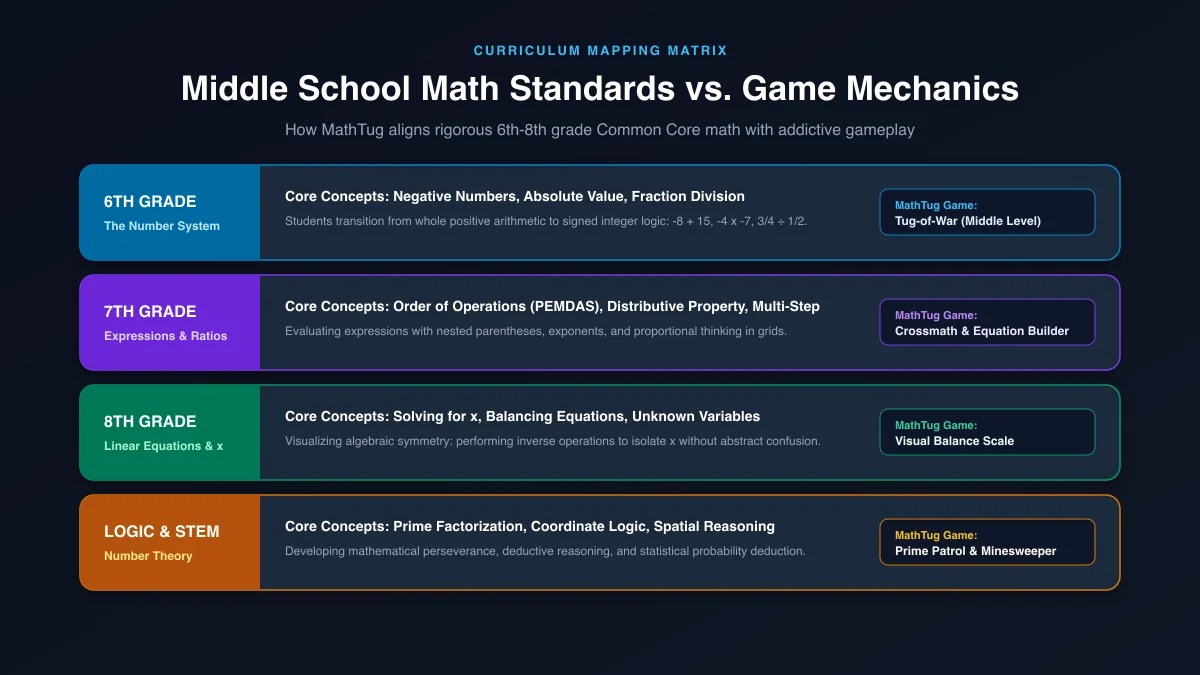
Every game on MathTug is mapped directly to the Common Core State Standards (CCSS) for Grades 6 through 8:
Top 10 Free Middle School Math Games on MathTug
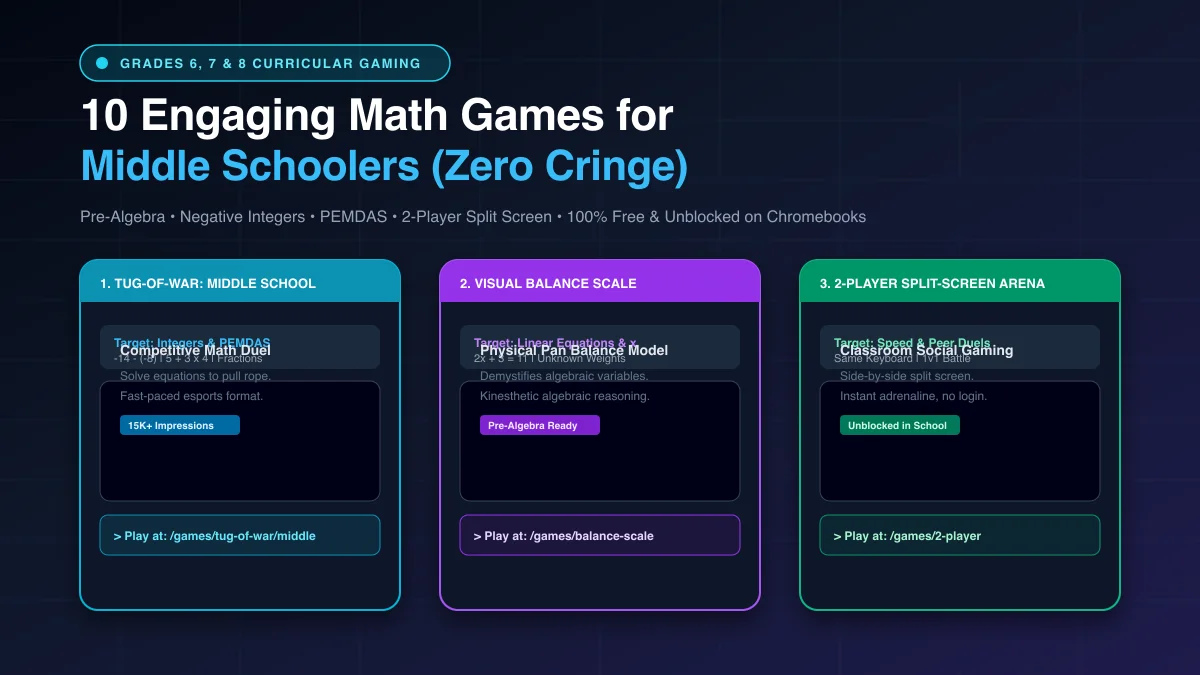
1. Middle School Math Tug-of-War
Grades 6–8 • CCSS 6.NS / 7.EEThe flagship arena of MathTug! Two players or teams pull on opposite ends of a virtual rope by calculating integer arithmetic, fraction division, and multi-step PEMDAS equations faster than their opponent.
-14 - (-8) = ? | 3/4 ÷ 1/2 = ? | 5 + 3 × (6 - 2) = ?2. Visual Balance Scale (Pre-Algebra & Solving for x)
Grades 7–8 • CCSS 7.EE / 8.EE
Most middle schoolers struggle with abstract algebra because equations like 2x + 5 = 17 seem disconnected from reality. This game grounds algebra in physical symmetry: unknown mystery boxes and numbered weights sit on a pan balance. Students isolate $x$ by adding or removing weights from both sides to keep the beam level.
3. Crossmath (Math Crossword Puzzles)
Grades 6–8 • Deductive LogicCombines the strategic deduction of Sudoku with arithmetic equations. Students place numbers into a crossword grid where horizontal and vertical equations must intersect and evaluate correctly under standard order of operations.
4. 2-Player Split-Screen Arena
Grades 6–8 • Same-Keyboard 1v1Turn any single school Chromebook or laptop into an arcade math duel. Two students sit shoulder-to-shoulder, using opposite sides of the keyboard (WASD vs. Arrow Keys) to buzz in and calculate solutions in rapid-fire rounds.
5. Equation Builder
Grades 6–7 • CCSS 6.EE / 7.EE
Instead of passively calculating answers, students are given scrambled number and operator tiles (+, -, ×, ÷, =) and must construct valid algebraic expressions that evaluate to true statements.
6. Math Minesweeper (Coordinate Logic & Probability)
Grades 7–8 • Statistics & ProbabilityThe classic retro logic game reimagined with mathematical coordinate planes and statistical probability deduction. Students analyze clue cells to calculate risk percentages before flagging hidden bomb tiles.
7. Prime Patrol (Number Theory & Divisibility)
Grade 6 • CCSS 6.NS.B.4Rapid-fire arcade game testing divisibility rules, prime factorization, and Greatest Common Factor (GCF). Incoming numbers must be categorized as Prime or Composite before they reach the defensive perimeter.
8. Target Crafter (Countdown-Style Arithmetic Logic)
Grades 6–8 • Complex PEMDASInspired by the British television game show Countdown. Students receive six randomly generated numbers and must combine them using addition, subtraction, multiplication, and division to reach a precise three-digit target number.
9. Classroom Smartboard Tug-of-War Tournament
Whole Class • Interactive GameshowProjected on the front interactive Smartboard or classroom display. Divide your class into two giant teams using the Team Generator and track points on the Digital Scoreboard. Students take turns coming up to tap correct answers to pull the class rope!
10. Custom Excel/CSV Spreadsheet Math Battles
Any Grade • Teacher-Created Content
Have a specific district quiz or vocabulary set on linear slope (y = mx + b) or geometric angles? Teachers can upload their own spreadsheet (.xlsx or .csv) containing up to 100 custom questions. The software converts your spreadsheet into an animated 2-player Tug-of-War battle instantly!
How to Integrate Math Games Without Losing Classroom Control
Middle school teachers often hesitate to use educational games because energetic 13-year-olds can quickly escalate into loud chaos. Here is the proven playbook for smooth implementation:
-
1. Mandatory Scratchwork Verification ("Show Your Work to Win")
Establish a non-negotiable rule during 2-player battles: every calculation must be scribbled on a mini whiteboard before tapping an answer. This completely prevents rapid random guessing and reinforces authentic procedural calculation.
-
2. Run the Smartboard Noise Meter in the Background
Launch the free Classroom Noise Meter in a background browser tab. If excited banter crosses the Level 2 threshold, the alarm sounds and both players lose 5 points. Middle schoolers quickly police each other’s volume!
-
3. The 10-Minute Station Rotation Model
Never let students play games for 45 continuous minutes. Keep gaming structured as a high-intensity 15-minute reward station in your 4-Station Rotation Schedule, paired with paper practice using the Worksheet Generator.
Frequently Asked Questions (FAQ)
Are these math games unblocked on school Chromebooks?
Yes. MathTug is categorized under Educational / Mathematics domains by major school filtering software (including GoGuardian, Securly, and Lightspeed). Because there are no Flash dependencies, third-party chat lobbies, or invasive video ads, the entire domain loads reliably on district networks.
Do students or teachers need to create an account?
No! All ten games are 100% free with zero registration, passwords, or email sign-ups required. Students open the URL and begin playing within five seconds.
Can these games be played on iPads or touchscreens?
Yes. All games are fully responsive and touch-optimized for interactive Smartboards, Promethean boards, iPads, and standard desktop Chromebooks.
Explore All Middle School Math Battles Today
Ready to banish math boredom from your 6th, 7th, or 8th grade classroom? Head directly to the Middle School Math Tug-of-War, pair up your students on Chromebooks, and watch engagement soar!
Looking for more teaching tools? Explore our guides on Custom Math Worksheets with Answer Keys, Smartboard Scoreboards, and Classroom Noise Meters.
Recommended Hands-on Math & Focus Tools
Top-rated learning tools on Amazon that support the strategies in this article:
📥 Get Our Free Classroom Math Puzzles & Worksheets
Enjoyed this guide? Join our educator community and receive weekly printable activities and mental math worksheets.
About the Author: Shubham
Math Educator & Developer
Shubham is a dedicated math educator and software engineer with a passion for gamifying education. He created MathTug to help teachers and parents utilize interactive digital games on smartboards and projectors to make math learning collaborative, active, and stress-free for kids.
Learn more about our educational mission on the About Us page →Enjoyed this post?
Share it with your colleagues or explore more fun ways to teach math on MathTug.
🎮 Play Games