
Differentiated Math Instruction: How to Assess & Support Mixed-Ability Classrooms Online
Teaching a classroom where some students calculate pre-algebra while others struggle with basic subtraction? Discover how to implement the 3-Tier MTSS framework with zero-prep digital exit tickets, untimed sensory modes, and 1-click gradebook CSV exports.
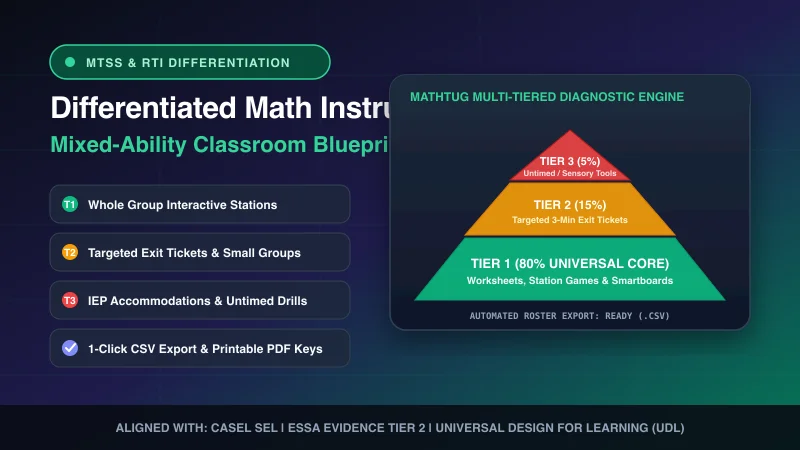
Every veteran educator knows the secret truth of K–8 education: there is no such thing as an "average" classroom. On any given Monday, a 4th-grade math teacher stands before twenty-eight distinct learners whose mathematical readiness spans five full grade levels.
In the front row, three students solve multi-digit multiplication in their heads and tap their fingers impatiently. In the middle row, fifteen students grasp the day's standard with guided modeling. And in the back row, four neurodivergent students with math anxiety or ADHD shut down completely the moment a timed quiz is announced, while two English Language Learners struggle to decode word-problem syntax.
Delivering a single, uniform lecture to this diverse room fails everyone: advanced learners disengage into boredom, while struggling students fall further behind. Yet attempting to handcraft three different paper worksheets every night leads to teacher burnout.
The solution is a structured, technology-assisted Multi-Tiered System of Supports (MTSS). By combining agile digital diagnostics, untimed sensory options, and zero-prep paper backups, teachers can differentiate instruction seamlessly in under ten minutes a day. Here is your comprehensive guide to differentiated math instruction in mixed-ability classrooms.
The 3-Tier MTSS Framework for Mathematics
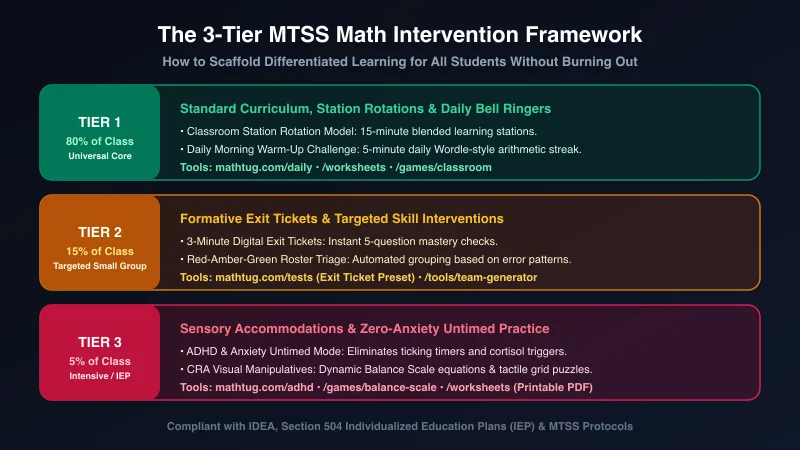
Federal guidelines under the Every Student Succeeds Act (ESSA) and the Individuals with Disabilities Education Act (IDEA) emphasize multi-tiered frameworks to catch learning gaps before they widen. Here is how modern teachers operationalize differentiation across each tier using MathTug's ecosystem:
Tier 1: Universal Core Instruction (80% of Students)
Tier 1 represents the standard, high-quality mathematical instruction delivered to the entire classroom. To ensure Tier 1 remains engaging without leaving students behind:
- Daily Math Bell Ringers: Start the period with a 5-minute Daily Arithmetic Challenge. Students guess hidden equations using Wordle-style feedback tiles, activating number sense without grading pressure.
- Blended Station Rotations: Organize the classroom into four 15-minute stations: Teacher-Led Small Group, Collaborative 2-Player Battles (Math Tug of War), Independent Practice Worksheets, and Digital Fluency.
- Clean Printable Worksheets: Use our Worksheet Generator to generate zero-ad, photocopier-ready student practice sheets paired with instantaneous teacher answer keys.
Tier 2: Targeted Small-Group Intervention (15% of Students)
Tier 2 provides short, focused remediation for students exhibiting specific skill deficits (e.g., regrouping in subtraction, or 7-times-table hesitation):
- 3-Minute Digital Exit Tickets: At the conclusion of a lesson, launch a 5-question formative check on MathTug Tests. With zero logins required, students complete the assessment in three minutes on their Chromebooks or tablets.
- Red-Amber-Green Roster Triage: Sort students instantly based on performance. Students scoring in the "Red" tier receive targeted 10-minute intervention during tomorrow's station rotation, while "Green" tier students advance to higher-order logic puzzles.
- Dynamic Group Formation: Use the Random Team Generator to group students into balanced peer-coaching duos.
Tier 3: Intensive IEP & Neurodivergent Accommodations (5% of Students)
Tier 3 delivers individualized accommodations mandated by Section 504 plans and Individualized Education Programs (IEPs):
- Sensory & Untimed Game Mode: Ticking timers flood children with cortisol, shutting down the prefrontal cortex. MathTug's dedicated ADHD & Neurodiversity Hub replaces high-pressure timers with self-paced exploratory play.
- Concrete-Representational-Abstract (CRA) Manipulatives: For students struggling with abstract algebraic variables, the Balance Scale Equation Game grounds algebraic equivalence in physical fulcrum mechanics.
- Paper Assessment Fallback: For students with IEP accommodations requiring offline testing or zero-screen environments, the 1-click "Print Paper Quiz & Answer Key" button on MathTug Tests creates an identical paper exam formatted for clean printing.
The 4-Step Daily Formative Diagnostic Loop
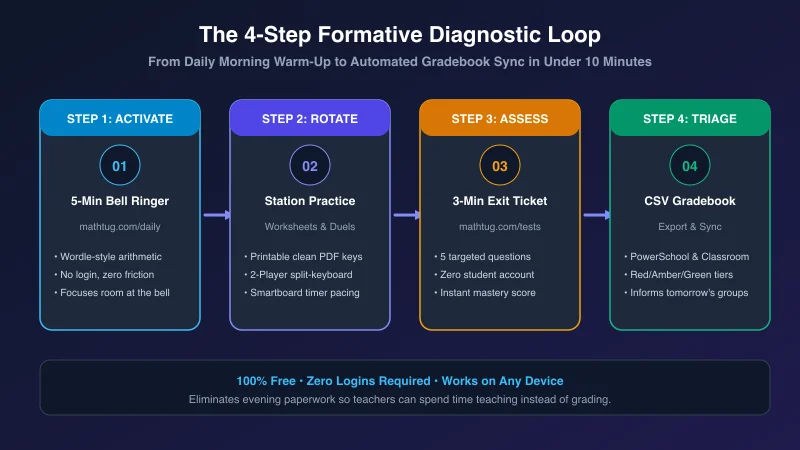
Differentiating instruction does not require working twelve-hour days. By implementing this streamlined 4-step diagnostic loop, your assessment data continuously informs your small-group instruction with zero manual paperwork:
Step 1: Activate Prior Knowledge (5 Minutes)
Students arrive, open their Chromebooks, and navigate to mathtug.com/daily. The 5-minute warm-up gets every pencil moving and surfaces immediate misconceptions before direct instruction begins.
Step 2: Differentiated Station Practice (20 Minutes)
While the teacher leads an intensive guided group at Table 1, other students rotate between 2-Player Split-Screen Battles on Chromebooks and targeted skill sheets from our Worksheet Generator.
Step 3: Instant 3-Minute Exit Ticket (3 Minutes)
Three minutes before class dismisses, students complete a 5-question mastery check on MathTug Tests. With zero account logins or passwords to forget, the entire class finishes before the bell rings.
Step 4: One-Click Gradebook Sync & Triage (60 Seconds)
Click "Export Gradebook (CSV)" on the results dashboard. Instantly download a standardized spreadsheet containing student names, percentage scores, time-on-task, and error categories—ready to upload directly into PowerSchool, Google Classroom, Canvas, or Infinite Campus!
Accommodating Math Anxiety & Executive Function Deficits
One of the greatest obstacles to valid mathematical assessment is test anxiety. When an anxious child stares at a countdown timer, their working memory capacity shrinks by up to 50%, producing scores that reflect panic rather than true conceptual understanding.
Universal Design for Learning (UDL) guidelines recommend providing multiple means of engagement and expression. In MathTug:
- Untimed Diagnostic Toggles: Disable countdown clocks on practice tests to observe pure mathematical reasoning without time pressure.
- Instant Explanations: Every quiz question features step-by-step mathematical reasoning so students learn immediately from incorrect attempts.
- Zero Public Shaming: Scores remain private to the student's screen unless the teacher chooses to project team challenges via the Smartboard Scoreboard.
Differentiated Math Tools Matrix: Match Learner Needs in Seconds
| Learner Profile | Common Obstacle | Recommended MathTug Tool | Instructional Strategy |
|---|---|---|---|
| Tier 3 (Math Anxiety) | Panic during timed drills | ADHD Untimed Hub | Untimed self-paced mastery with visual manipulatives |
| Tier 3 (IEP Paper Only) | Screen fatigue or 504 mandate | Tests Printable PDF | Print clean offline paper quiz with teacher answer key |
| Tier 2 (Struggling Facts) | Hesitation on 6×, 7×, 8× tables | Tug of War 2-Player | Peer-scaffolded split-screen battle with handicap offset |
| Tier 1 (Core Class) | Disorganized morning arrivals | Daily Bell Ringer | 5-minute morning arithmetic streak on Smartboard |
| Advanced Fast Finishers | Boredom & rushing ahead | Balance Scale Algebra | Multistep variable balancing & spatial coordinate puzzles |
Empower Every Learner Without the Paperwork
True differentiation is not about teaching three separate lessons—it is about providing flexible pathways for every student to access grade-level standards.
When you replace manual paper grading with zero-login digital diagnostics, untimed sensory accommodations, and instant CSV exports, you reclaim your evenings while ensuring no student slips through the cracks.
Explore mathtug.com/tests for instant exit tickets, generate custom practice sheets at mathtug.com/worksheets, and create the responsive, inclusive math classroom your students deserve.
Related differentiation resources: Zero-Login Math Quiz Maker & CSV Export, Digital Exit Tickets for Math Formative Assessment, The 4-Station Math Blended Learning Blueprint, Overcoming Math Anxiety with Untimed Games, and Split-Screen Math Battles 2-Player Guide.
Recommended Hands-on Math & Focus Tools
Top-rated learning tools on Amazon that support the strategies in this article:

📥 Get Our Free Classroom Math Puzzles & Worksheets
Enjoyed this guide? Join our educator community and receive weekly printable activities and mental math worksheets.
About the Author: Shubham
Math Educator & Developer
Shubham is a dedicated math educator and software engineer with a passion for gamifying education. He created MathTug to help teachers and parents utilize interactive digital games on smartboards and projectors to make math learning collaborative, active, and stress-free for kids.
Learn more about our educational mission on the About Us page →Enjoyed this post?
Share it with your colleagues or explore more fun ways to teach math on MathTug.
🎮 Play Games