
The Problem with Timed Math Drills (And Why "No-Timer" Games Cure Math Anxiety)
Does a ticking timer make your students freeze up? Discover the cognitive neuroscience of math anxiety, why "Mad Minutes" damage fact recall, and how self-paced, untimed math games unlock deep mathematical confidence.
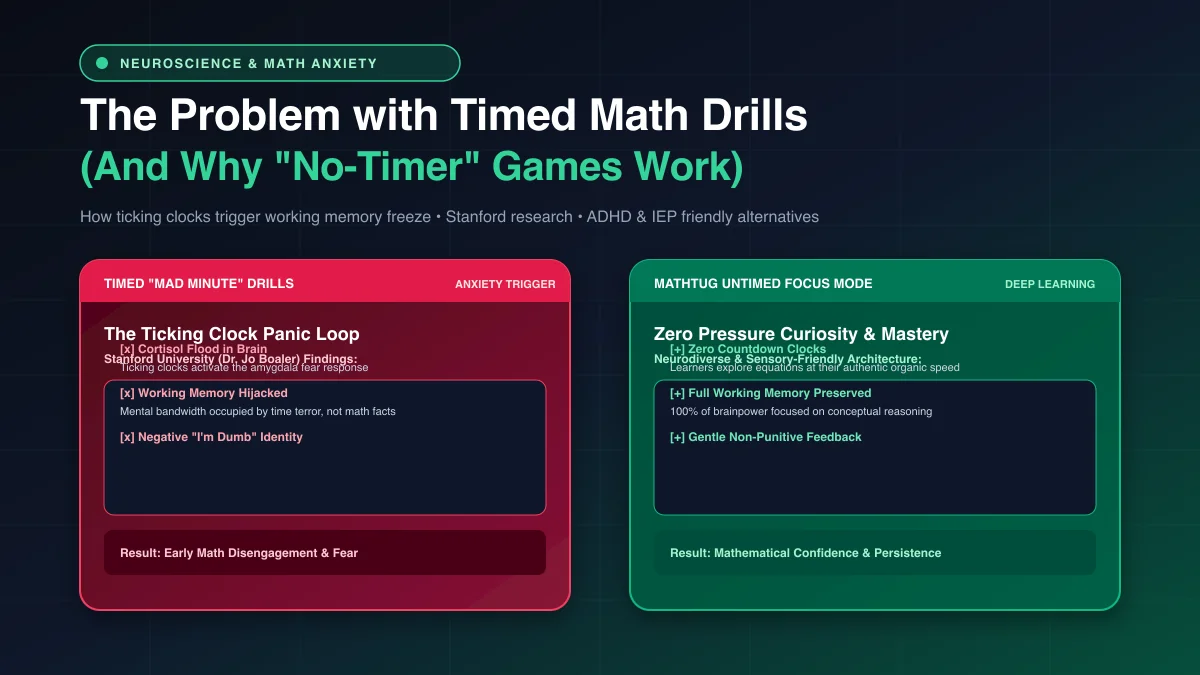
Picture an elementary classroom at 9:15 AM. The teacher places a face-down piece of paper on every desk: a 60-second "Mad Minute" containing fifty multiplication facts. The teacher raises their stopwatch: "Pencils up... Ready, set, GO!"
For two or three students with rapid natural processing speeds, this is an exhilarating sprint. But for more than a third of the classroom, an immediate physiological horror takes over: palms grow clammy, heart rates spike, stomach cramps flare up, and their minds go completely, terrifyingly blank.
Students stare at simple equations like 7 × 8—facts they knew perfectly the night before at the kitchen table—and cannot recall a single number. When the timer beeps, they turn in a half-finished sheet stained with sweat and tears, internalizing a devastating, lifelong self-fulfilling prophecy: "I am just stupid at math."
For decades, timed arithmetic drills were treated as the holy grail of fact fluency. Today, cognitive neuroscientists, educational psychologists, and leading mathematicians agree: timed math drills are the single largest contributing cause of early math anxiety in children. To build authentic fact fluency, schools are replacing ticking countdowns with sensory-friendly, self-paced platforms like the MathTug Untimed & ADHD Focus Hub.
The Neurobiology of the "Brain Freeze": The Amygdala Hijack
When a child experiences math anxiety during a timed test, they are not suffering from a lack of mathematical intellect. They are experiencing an involuntary, evolutionary neurochemical event known as the Amygdala Hijack:
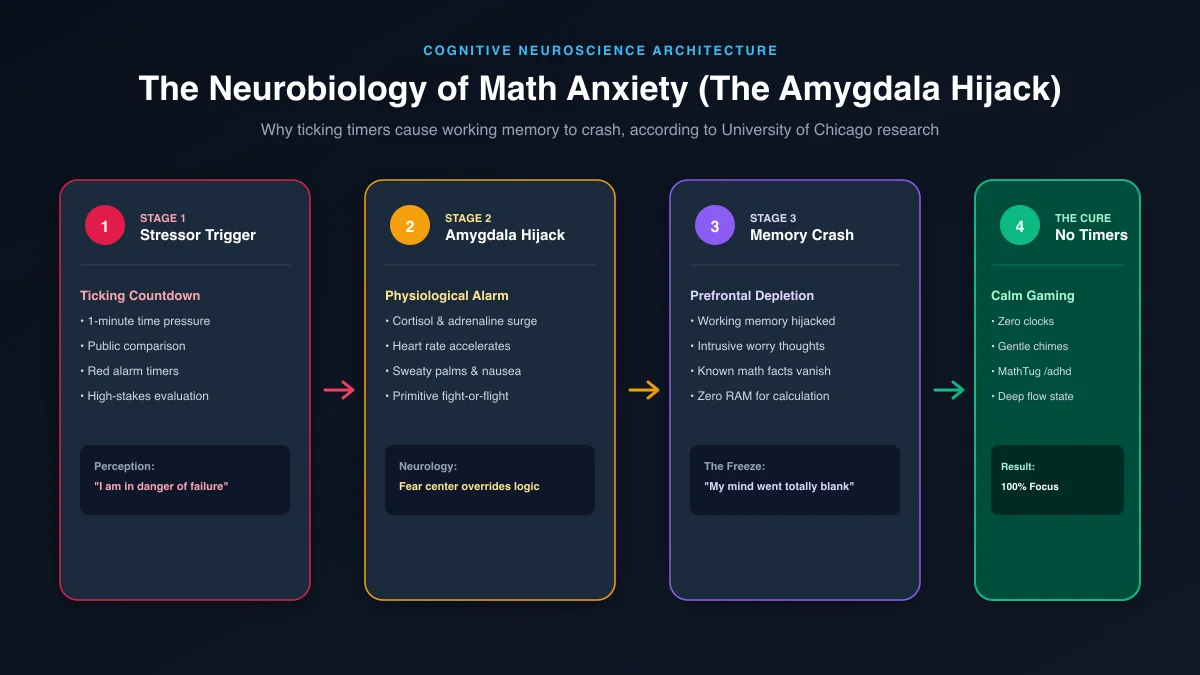
Dr. Sian Beilock, a renowned cognitive scientist and president of Dartmouth College, conducted seminal fMRI brain-imaging research on math anxiety at the University of Chicago. Her findings uncovered a startling neurological truth:
-
1. Working Memory is a Finite Cognitive Cache
Working memory—located in the prefrontal cortex—is the brain’s mental scratchpad. It is where students temporarily hold partial products, regrouping values, and numerical steps while calculating math problems. In elementary and middle schoolers, working memory can only hold 3 to 5 chunks of data simultaneously.
-
2. Fear Thoughts Completely Consume Mental Bandwidth
When a timer is placed in front of an anxious student, the brain perceives an imminent threat. The amygdala activates, flooding the body with cortisol and adrenaline. The prefrontal cortex becomes inundated with intrusive, catastrophic thoughts: "Everyone else is writing faster than me! If I fail this, I'll be put in the slow group! I have 20 seconds left!" These worry thoughts consume 100% of working memory bandwidth, leaving zero bytes of mental RAM to retrieve basic arithmetic facts.
-
3. The Freeze is Physiological, Not Academic
The student didn't forget what
8 × 7was because they are bad at math. The brain’s retrieval circuitry was physically shut down by a biological stress response. Remove the timer, and the same student can calculate8 × 7 = 56instantly with a smile on their face!
The Dangerous Myth: Confusing Speed with Mathematical Brilliance
In standard school culture, speed is mistakenly equated with high intelligence. The student who blurts out answers in two seconds is labeled a "genius," while the student who pauses to visualize numbers is labeled "slow."
Yet in the real world of professional STEM, mathematics is not a speed competition. Deep mathematics is slow, contemplative, visual, and highly creative. As Stanford University mathematics education professor Dr. Jo Boaler emphasizes in her research:
"Timed tests cause the early onset of math anxiety for students across the achievement spectrum. When we emphasize speed, we send the completely false message that math is about fast performance rather than deep, flexible mathematical thinking."
Consider the legendary French mathematician Laurent Schwartz, who was awarded the Fields Medal (the highest honor in mathematics, equivalent to the Nobel Prize). In his autobiography, Schwartz revealed that he felt stupid in school because he was slow at timed math tests:
"I was always deeply uncertain of my intellectual ability; I thought I was unintelligent. And it is true that I was, and still am, rather slow. I need time to seize things because I always need to understand them completely. Rapidity doesn't have a precise relation to intelligence. What is important is to deeply understand things and their relations to each other."---
Head-to-Head: Timed Drills vs. Untimed Fact Fluency Games
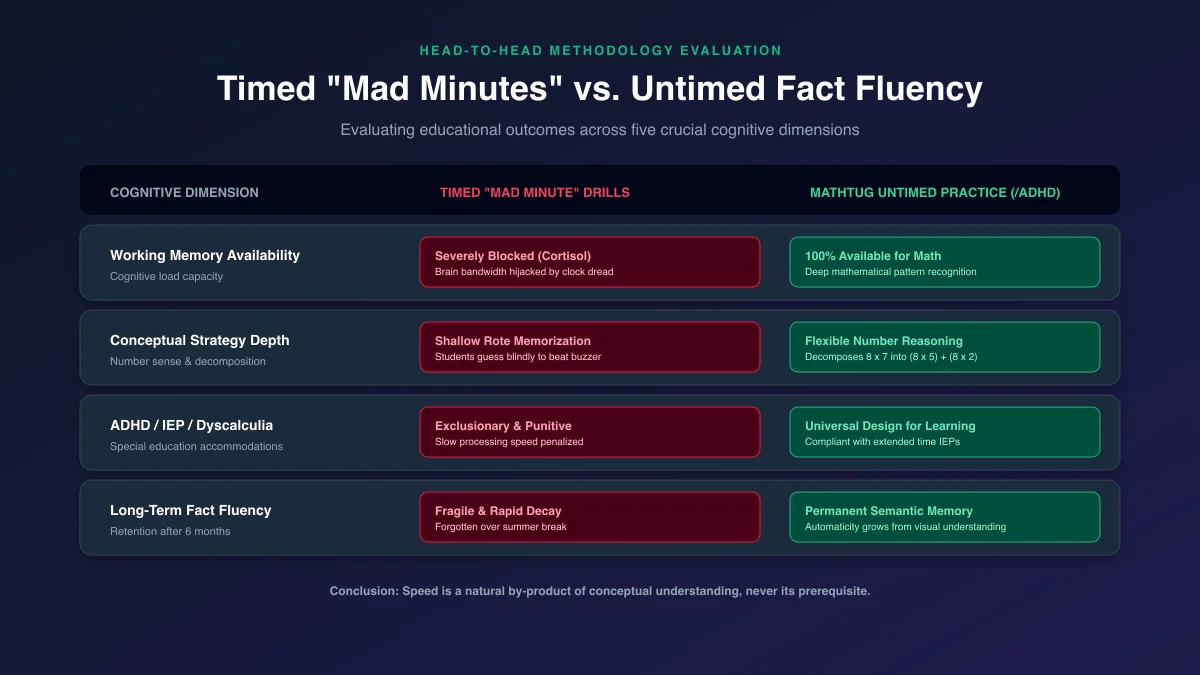
| Evaluation Metric | Timed "Mad Minute" Drills | MathTug Untimed Focus Mode |
|---|---|---|
| Working Memory Availability | Severely Blocked by Cortisol | 100% Free for Numerical Processing |
| Cognitive Strategy | Blind guessing & rote regurgitation | Number decomposition (e.g. 7×6 = 7×5 + 7) |
| ADHD & Neurodiversity Impact | Triggers meltdowns & executive dysfunction | Sensory-friendly, calming flow state |
| Attitude Toward Mistakes | Catastrophic penalty (score drops) | Gentle feedback: curiosity & instant retry |
| 6-Month Fact Retention | Rapid decay over holidays | Permanent semantic long-term memory |
Inside the MathTug Untimed & ADHD Focus Hub
To provide classrooms and homeschooling families with an evidence-based alternative to timed pressure, MathTug built the dedicated ADHD & Focus Math Hub. Every game in this collection is built upon Universal Design for Learning (UDL) principles:
Zero Countdown Clocks
There is no ticking timer, no red flashing border, and no countdown siren. Learners explore numbers at their authentic, natural cognitive rhythm without clock dread.
Gentle, Non-Punitive Feedback
Incorrect inputs do not trigger harsh, jarring buzzers or deduct hard-earned points. The interface simply shakes gently and lets the student try again, reframing errors as natural learning milestones.
Minimalist Visual Architecture
Cluttered screens trigger sensory overwhelm in neurodivergent learners. MathTug Focus Mode eliminates flashy sidebar ads, dancing cartoon animals, and high-frequency visual noise, directing 100% of visual attention to mathematical equations.
Multiple Solution Pathways
Games like Target Crafter and Visual Balance Scale allow students to reach target numbers using multiple valid arithmetic combinations, honoring divergent creative thinking.
5 Actionable Strategies to Dismantle Math Anxiety in Your Classroom
-
1. Ban "Mad Minutes" and Timed Public Drills Immediately
If you want to assess fact fluency, use untimed private assessments. If you need a fast formative check, deploy a 5-question Exit Ticket where students have generous time to think, rather than a 50-question speed gauntlet.
-
2. Celebrate Strategy Talk Over Speed
When a student solves
6 × 7, never praise them with "Wow, you were so fast!" Instead, ask: "How did you see that number in your head?" If they reply: "I knew 6×5 is 30, and then I added two more sixes to get 42," praise their strategic number sense! That builds resilient mathematical identity. -
3. Fulfill IEP & 504 Accommodations with Untimed Tech
Special education plans frequently mandate "extended time" or "low-distraction environments." Direct these students to the MathTug ADHD Focus Mode during Station Rotations. They receive the exact same high-quality visual games as their peers without countdown embarrassment.
-
4. Use Visual Timers as Structure, NOT Pressure
Timers are wonderful for station transitions, but should never be applied to individual problem solving. When running classroom rotations, project the MathTug Visual Timer set to 15 minutes with soothing Lo-Fi background music so students know when to rotate—not how fast to calculate.
-
5. Deploy Low-Stakes Paper Practice
When students do paper worksheets, use the MathTug Worksheet Generator set to 12 or 20 questions with generous white space. Encourage students to self-check with laminated answer keys in pencil, turning mistakes into private learning moments.
Frequently Asked Questions (FAQ)
If we eliminate timed tests, how will students ever develop fast fact fluency?
Speed is a natural by-product of deep conceptual understanding, not its prerequisite. When students play visual games like Balance Scale and Bubble Pop, they internalize number relationships and patterns. Over time, retrieval becomes instantaneous through automaticity, not through fear of a ticking stopwatch.
Is the MathTug ADHD Focus Mode really 100% free with no login?
Yes. There are no subscriptions, student logins, or paywalls. Simply navigate to mathtug.com/adhd on any Chromebook, iPad, or desktop computer to launch calm, self-paced learning instantly.
Can these games be used for dyscalculia interventions?
Yes! Dyscalculia is characterized by severe difficulty in processing numerical quantities. Games like Bubble Pop and Visual Balance Scale provide multisensory visual and spatial representations that help students with dyscalculia develop foundational number sense without cognitive overload.
Start Low-Stress Math Practice Today
Every child deserves to experience the beauty and joy of mathematics without the paralyzing fear of a ticking clock. Visit the MathTug ADHD & Untimed Focus Hub, explore calm mathematical puzzles, and watch your students rediscover their natural mathematical confidence.
Looking for more teaching guides? Explore our articles on Teaching Pre-Algebra with Visual Balance Scales, Why Visual Timers Reduce Classroom Anxiety, and The 4-Station Math Blended Learning Blueprint.
Recommended Hands-on Math & Focus Tools
Top-rated learning tools on Amazon that support the strategies in this article:
📥 Get Our Free Classroom Math Puzzles & Worksheets
Enjoyed this guide? Join our educator community and receive weekly printable activities and mental math worksheets.
About the Author: Shubham
Math Educator & Developer
Shubham is a dedicated math educator and software engineer with a passion for gamifying education. He created MathTug to help teachers and parents utilize interactive digital games on smartboards and projectors to make math learning collaborative, active, and stress-free for kids.
Learn more about our educational mission on the About Us page →Enjoyed this post?
Share it with your colleagues or explore more fun ways to teach math on MathTug.
🎮 Play Games