
How to Teach Pre-Algebra with a Visual Balance Scale Game (The Secret to Making "x" Make Sense)
Why do so many students hit an emotional wall when letters enter math? Discover how using a visual balance scale transforms abstract variables into intuitive physical equilibrium, making solving for x click in minutes.
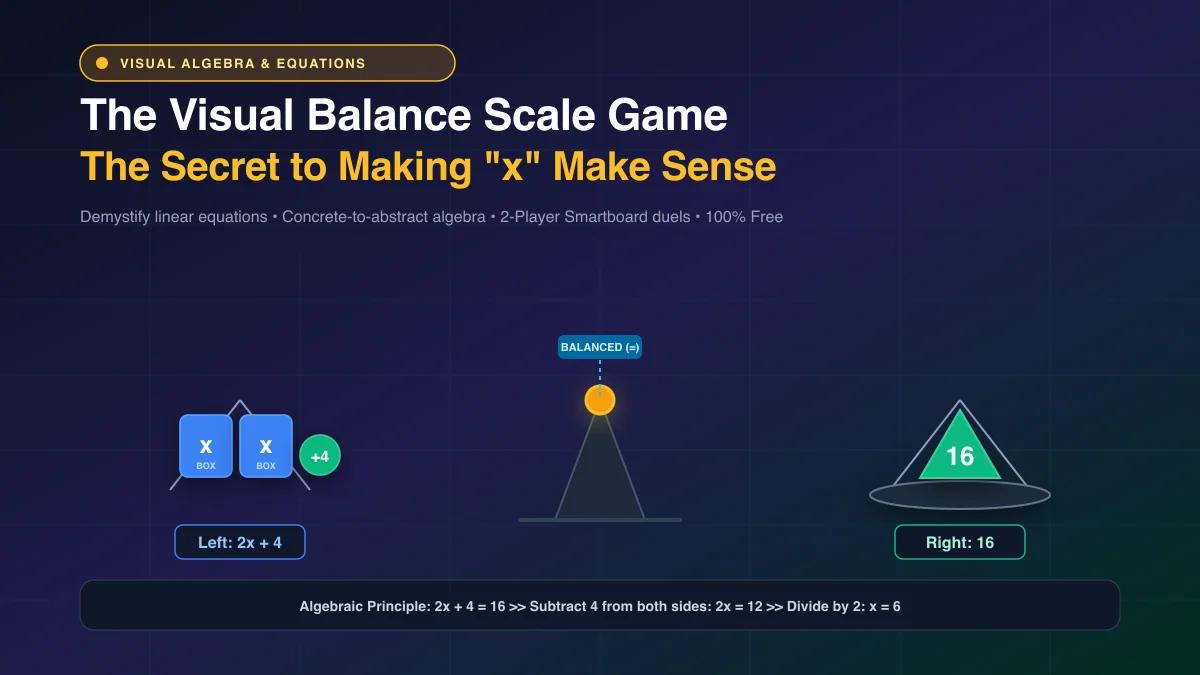
In elementary arithmetic, the equals sign (=) has a simple, comfortable meaning to children: "Calculate the answer." When a 3rd grader sees 7 + 5 = ___, their brain reads it as an operational command: take 7, add 5, write 12 in the blank.
Then comes 6th or 7th grade pre-algebra. Suddenly, students are confronted with equations like 2x + 5 = 19 or 3x - 4 = x + 10. To a child who views = as "the answer goes here," these expressions look completely nonsensical. What is $x$? How can an answer have letters? Why are there numbers on both sides of the equals sign?
This cognitive barrier is known in educational psychology as the "Algebra Wall." When teachers attempt to force-feed abstract rules—such as "subtract 5 from both sides" or "flip the sign when you cross the equal sign"—students memorize procedures without understanding. They make fatal algebraic errors, confuse variables, and conclude: "I'm just not a math person."
The solution is not more rote drills. The solution is grounding algebraic equality in physical intuition using the Visual Balance Scale Model. Through the interactive MathTug Balance Scale Game, students don't memorize rules—they physically see and manipulate mathematical equilibrium.
The C-R-A Framework: How the Brain Encodes Algebra
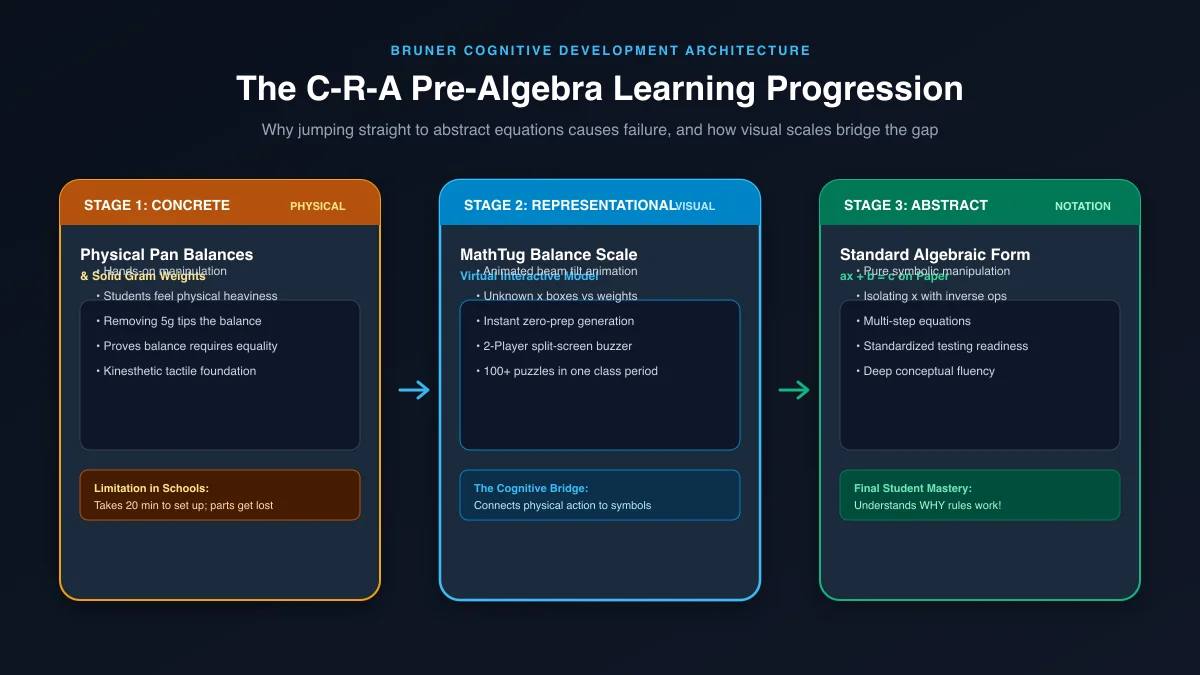
Cognitive psychologist Jerome Bruner proved that children acquire mathematical mastery through a strict three-stage progression: Concrete $ ightarrow$ Representational $ ightarrow$ Abstract (C-R-A). When schools attempt to teach algebra by jumping straight from elementary arithmetic into Stage 3 (Abstract symbols), cognitive overload occurs.
-
Stage 1: Concrete (Physical Pan Balances & Gram Weights)
Students place actual weights into two hanging plastic pans. If one pan contains 15 grams and the other contains 10 grams, the scale visibly tips downwards. Students physically experience that balance requires equal mass on both sides. However, physical scales in classrooms are messy, weights get lost, and setting up thirty scales takes 20 minutes of teacher prep.
-
Stage 2: Representational (The MathTug Virtual Interactive Scale)
The MathTug Balance Scale serves as the critical cognitive bridge. On interactive Smartboards or Chromebooks, an animated golden beam tilts $-12^circ$ or $+12^circ$ whenever student inputs are too low or too high. Unknown variables are represented as mystery boxes labeled $x$, sitting alongside known integer weights. Students solve dozens of visual puzzles in minutes with zero cleanup.
-
Stage 3: Abstract (Standard Algebraic Notation)
Once the visual neural pathway is established, students transition seamlessly to standard symbolic pencil-and-paper algebra on MathTug Custom Worksheets. When they see
2x + 4 = 12on paper, their mind's eye visualizes the scale beam, naturally knowing why inverse operations are required.
Step-by-Step Visual Proof: Solving 2x + 4 = 12
Why do algebra teachers constantly repeat: "Whatever you do to one side of the equation, you MUST do to the other side"? To a novice student, this sounds like an arbitrary, punitive rule invented by mathematicians. The balance scale proves it is a physical law of nature:
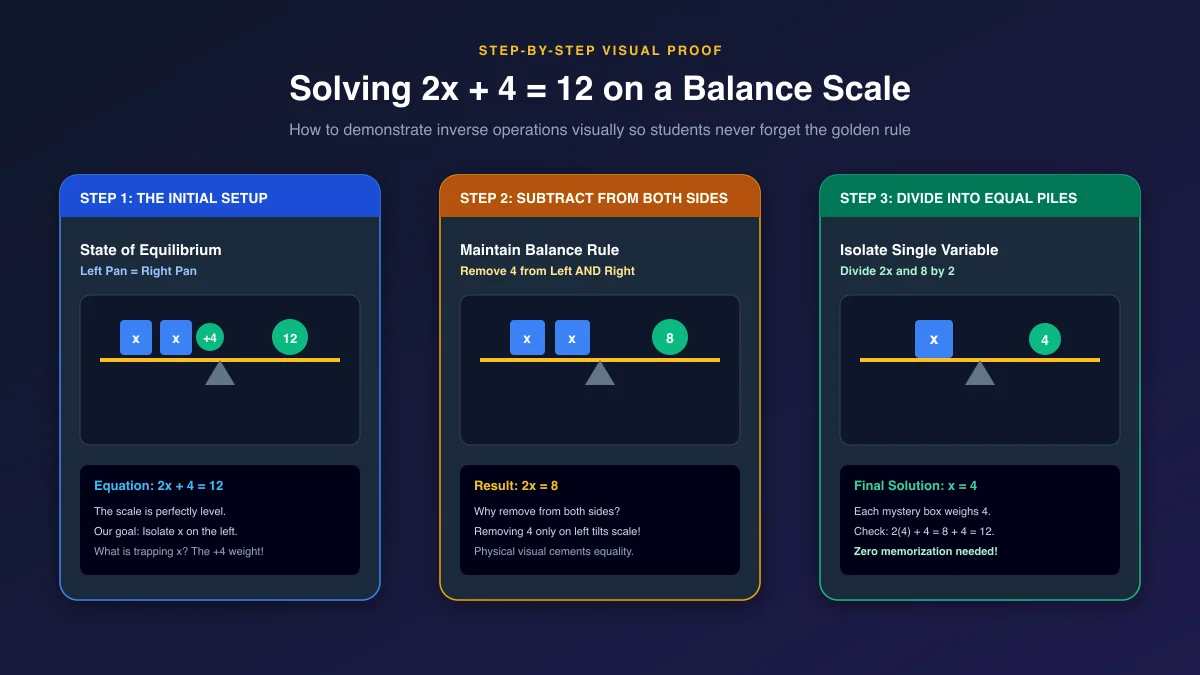
Step 1: The Initial State of Equilibrium (2x + 4 = 12)
On the left pan, we place two mystery boxes ($x$ and $x$) plus a green weight of $+4$. On the right pan, we place a solid weight of $12$. The horizontal beam is perfectly level. In algebraic notation, this represents 2x + 4 = 12. Our goal is simple: determine the weight of a single mystery box $x$.
Step 2: Performing Inverse Operations to Maintain Balance (2x = 8)
What is preventing $x$ from being isolated? The $+4$ weight on the left pan! If we physically pick up and remove that 4-unit weight, what happens to the scale? The right pan slams downward because the left side is now 4 units lighter!
To restore horizontal equilibrium, we must remove an identical 4 units from the right pan. 12 - 4 = 8. The beam levels out once again! Students immediately see that removing 4 from both sides is not an arbitrary rule—it is the only way to keep the scale balanced. The equation now visually reads: 2x = 8.
Step 3: Dividing into Equal Piles (x = 4)
We now have two identical mystery boxes on the left pan balancing 8 units on the right pan. To find the weight of a single box, we divide both sides into two equal groupings. 8 ÷ 2 = 4. Therefore, one mystery box $x$ must weigh exactly 4 units.
Check the solution: 2(4) + 4 = 8 + 4 = 12. Perfectly balanced! The student just solved a two-step linear equation without memorizing a single abstract formula.
Classroom Integration: 4 Ways to Teach with Balance Scales
5-Minute Pre-Algebra Bell Ringer
Project the MathTug Balance Scale on your front Smartboard as students walk into the room. Students grab their dry-erase markers and sketch the scale on their desks, racing to deduce the missing weight before the Classroom Countdown Timer chimes.
Station 4 in Math Rotations
In our 4-Station Math Blended Learning Rotation Model, Station 4 is dedicated to hands-on manipulatives. Students pair up on Chromebooks at the Balance Scale station, collaborating and debating algebraic strategies before moving to independent paper practice at Station 3.
2-Player Same-Keyboard Duel
MathTug Balance Scale features a built-in 2-Player mode where Team Blue and Team Red race to enter the balancing value first. The animated scale tilts dynamically with their inputs, turning algebraic reasoning into a high-stakes, esport-style duel.
Whole-Class Smartboard Tournament
Divide the room into two teams using the Random Team Generator and project the game on the big screen. Use the Digital Scoreboard to track points as student representatives come up to tap and balance mystery equations.
Differentiated Tiers: From Nursery to High School
The beauty of the balance scale mechanic is that it scales effortlessly across all developmental ages:
-
🐣 Nursery / Kindergarten (Ages 4–6):
Single-digit number conservation. Left pan:
3 + 2. Right pan:5. Teaches early learners that two smaller quantities combine to equal a single larger quantity. -
🎒 Primary (Ages 6–9 / Grades 1–3):
Missing addends and number bonds. Left pan:
8 + ?. Right pan:15. Replaces traditional subtraction drills with intuitive balance deduction. -
📚 Middle School (Ages 9–12 / Grades 4–6):
Multi-operation balance and times tables. Left pan:
4 × ?. Right pan:36. Introduces early division as the inverse of multiplication. -
📐 High School / Pre-Algebra (Ages 12–15 / Grades 7–9):
Two-step linear equations and variables on both sides. Left pan:
3x + 7. Right pan:x + 23. The ultimate preparation for formal high school algebra!
Frequently Asked Questions (FAQ)
Can students play against an AI bot if they don't have a partner?
Yes! The MathTug Balance Scale features an integrated AI robot opponent with adjustable difficulty speeds (1 to 5). Solo students can challenge the robot during independent station time or at home.
How does the virtual tilt animation help kinesthetic and visual learners?
When a student enters a guess, the virtual beam physically tilts $-12^circ$ (if the guess is too light) or $+12^circ$ (if too heavy). This immediate physical feedback activates visual-spatial reasoning, allowing students to self-correct their estimation without needing teacher intervention.
Is the Balance Scale game unblocked on school Chromebooks?
Yes. MathTug is 100% free with no login required, zero Flash plugins, and is unblocked under major school web filters (GoGuardian, Securly, Lightspeed).
Experience Visual Balance in Your Classroom Today
Stop watching your students dread pre-algebra. Open the MathTug Balance Scale Game on your Smartboard or Chromebooks, launch a 2-player match, and watch abstract equations instantly click into place.
Looking for more middle school resources? Check out our guides on 10 Engaging Middle School Math Games, Custom Math Worksheets with Answer Keys, and The 4-Station Math Rotation Model.
Recommended Hands-on Math & Focus Tools
Top-rated learning tools on Amazon that support the strategies in this article:
📥 Get Our Free Classroom Math Puzzles & Worksheets
Enjoyed this guide? Join our educator community and receive weekly printable activities and mental math worksheets.
About the Author: Shubham
Math Educator & Developer
Shubham is a dedicated math educator and software engineer with a passion for gamifying education. He created MathTug to help teachers and parents utilize interactive digital games on smartboards and projectors to make math learning collaborative, active, and stress-free for kids.
Learn more about our educational mission on the About Us page →Enjoyed this post?
Share it with your colleagues or explore more fun ways to teach math on MathTug.
🎮 Play Games