
Why Logic Puzzles (Like Arrow Puzzles) Make Kids Better at Math
Math is more than just calculations. Discover why logic and spatial puzzles are crucial for building problem-solving skills, resilience, and algebraic thinking in elementary students.
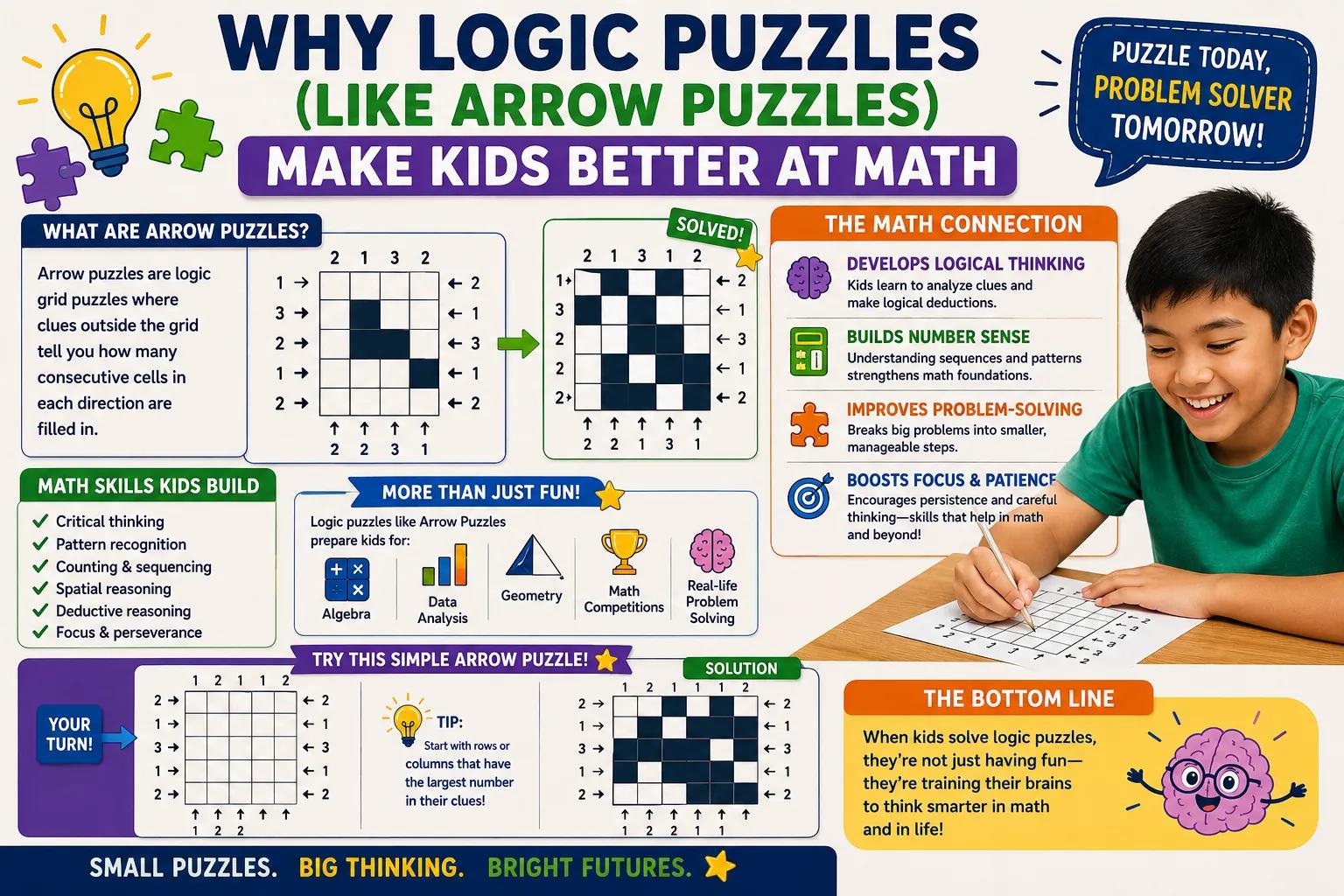
When parents ask me how they can help their children improve at math, they are often surprised by my answer. They expect me to recommend flashcards, workbooks, or tutoring apps.
Instead, I tell them: "Have your child play logic puzzles."
As a math educator and game developer, I have observed that the students who excel in mathematics are not necessarily those who can calculate the fastest. Rather, they are the ones who can think logically, spot patterns, and persevere when they get stuck.
Mathematics is not just the study of numbers; it is the science of patterns and logical reasoning.
This is why logic puzzles—such as grid puzzles, mazes, and spatial games like Arrow Puzzle—are crucial for a child's mathematical development. Here is how playing logic puzzles directly translates to classroom math success.
1. They Build Spatial Reasoning (The Geometry Connection)
Spatial reasoning is the ability to visualize and manipulate shapes and spaces in your mind.
- Why it matters: Research shows a direct link between strong spatial reasoning skills in early childhood and future success in high school geometry, physics, and STEM fields.
- How puzzles help: In games like Arrow Puzzle, players must place direction arrows to fill a grid. This requires them to mentally rotate shapes, project paths, and visualize outcomes before making a move. This is exactly what engineers and geometricians do.
2. They Teach the Foundations of Algebraic Thinking
Algebra is all about variables, balances, and step-by-step logic.
- Why it matters: Many students struggle with algebra because it feels too abstract. They struggle to find the value of
Xor understand how a change in one variable affects another. - How puzzles help: Logic puzzles are essentially visual algebra. To solve a grid maze or a number path, a child must think: "If I place this arrow here, then that path will be blocked. So, I must place it there instead." This "if-then" logic is the absolute foundation of coding, algebra, and logical proofs.
3. They Encourage Mathematical Resilience (Grit)
One of the biggest obstacles to math success is a lack of perseverance. Many students try a problem once, get it wrong, and give up.
- Why it matters: True mathematical problem-solving requires trial and error. Students must be comfortable with making mistakes and revising their strategies.
- How puzzles help: Puzzles are low-stakes. When a child fails to solve a puzzle level, they don't get a bad grade; they just press "restart" and try a new configuration. This builds a "growth mindset" where mistakes are viewed as necessary steps toward finding the solution.
4. They Improve Focus and Working Memory
Working memory is the brain's ability to hold and manipulate multiple pieces of information at the same time.
- Why it matters: Solving multi-step math problems (like long division or word problems) requires a strong working memory to keep track of steps.
- How puzzles help: Solving a complex logic puzzle requires a child to hold multiple constraints in their mind: "I need to fill the entire board, I cannot cross this line, and my paths cannot overlap." Working within these rules exercises the prefrontal cortex, expanding their working memory capacity.
How to Introduce Logic Puzzles to Your Child
To get the most cognitive benefits out of logic puzzles:
- Make it Cooperative: Don't just hand a puzzle to a child. Sit with them, project it on a screen, and talk through options together: "Let's test this path. What do you think will happen next?"
- Encourage Explanation: When they solve a puzzle, ask them: "How did you figure that out?" Explaining their strategy in words helps solidify their logical reasoning.
- Keep it Fun: Choose puzzles that have engaging designs, tactile drag-and-drop elements, and satisfying victory sounds to keep them motivated.
Conclusion
If you want to raise a child who is confident in math, look beyond the flashcards. Introduce them to the world of spatial puzzles, grids, and logic games. By playing games like Arrow Puzzle or solving riddles, they will develop the spatial reasoning, algebraic logic, and grit needed to master math in the classroom. Start playing today!
Recommended Hands-on Math & Focus Tools
Top-rated learning tools on Amazon that support the strategies in this article:
📥 Get Our Free Classroom Math Puzzles & Worksheets
Enjoyed this guide? Join our educator community and receive weekly printable activities and mental math worksheets.
About the Author: Shubham
Math Educator & Developer
Shubham is a dedicated math educator and software engineer with a passion for gamifying education. He created MathTug to help teachers and parents utilize interactive digital games on smartboards and projectors to make math learning collaborative, active, and stress-free for kids.
Learn more about our educational mission on the About Us page →Enjoyed this post?
Share it with your colleagues or explore more fun ways to teach math on MathTug.
🎮 Play Games