
Unlocking Prime Numbers: Fun Classroom Activities & Puzzles
Prime numbers can feel like a dry topic to teach. Discover five creative activities and puzzles that make prime and composite numbers visual, exciting, and memorable.
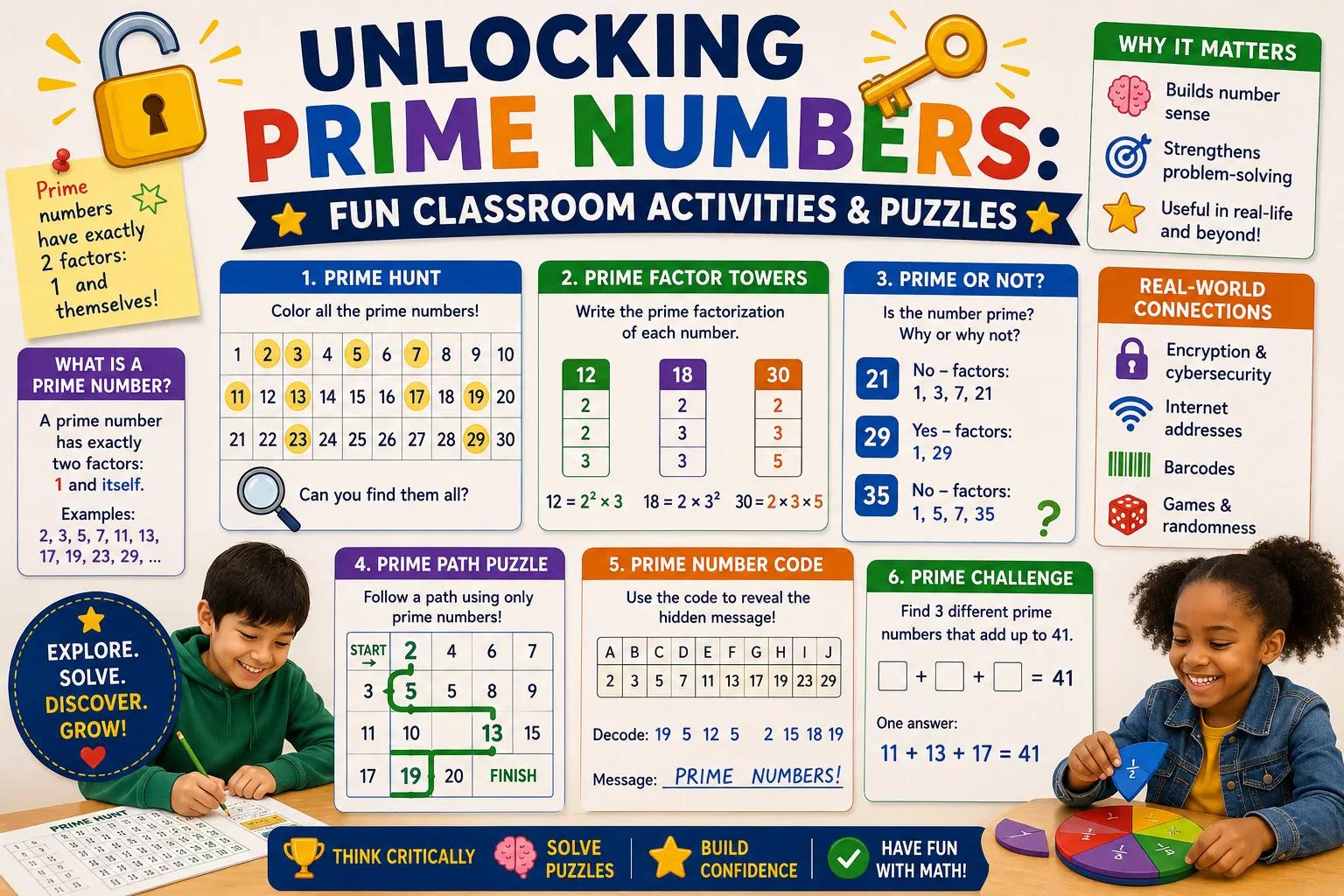
When I introduce prime numbers to my upper elementary students, I like to describe them as the "atoms" of the math world. Just like atoms are the building blocks of matter, prime numbers are the building blocks of all other numbers.
However, if we just define a prime number as "a number greater than 1 that has only two factors: 1 and itself," most kids will tune out.
In my experience as an educator, students often struggle with prime numbers because they confuse them with odd numbers. They assume that because 9 is odd, it must be prime, or because 2 is even, it cannot be prime.
To break these misconceptions, we need to show students what prime numbers look like visually and let them explore these properties through patterns and games. Here are five interactive activities to make prime numbers exciting and memorable.
1. Rectangle arrays (The Visual Proof)
- Best for: Visually proving why a number is prime or composite (Grades 3-5)
- What you need: Grid paper, color pencils, or plastic square tiles.
This is the absolute best way to demonstrate the difference between prime and composite numbers.
- How to play: Give students a number (e.g., 12). Ask them to draw or build as many different rectangles as they can using exactly 12 grid blocks. For 12, they can make a
1 x 12, a2 x 6, and a3 x 4rectangle. This means 12 is composite. Next, give them the number 7. They will quickly find that they can only build a1 x 7rectangle. - Why I recommend it: It physically proves the definition. A prime number is a number that can only make a single, thin rectangle array, while a composite number can make multiple rectangular shapes.
2. Interactive Digital Prime Patrol
- Best for: Quick recall and identifying primes under pressure (Grades 4-6)
- What you need: A smartboard or projector running the MathTug game.
Once students understand the concept, they need to build speed in recognizing prime numbers (especially below 50).
- How to play: Open MathTug on the projector and choose the "Prime Numbers" category. Students work in teams to identify which of the falling or displayed numbers are prime to win the tug-of-war.
- Why I recommend it: The fast pace prevents kids from writing down calculations. It forces them to apply quick divisibility rules (like checking if a number ends in 5 or if its digits add up to a multiple of 3) to make rapid, accurate decisions.
3. The Sieve of Eratosthenes (The Multiples Hunt)
- Best for: Finding all prime numbers up to 100 (Grades 4-6)
- What you need: A printed 1-100 grid chart and color highlighters.
This is a historic, hands-on math activity that dates back to ancient Greece.
- How to play: Give students a 1-100 chart.
- Cross out number 1 (it is neither prime nor composite).
- Keep 2, but highlight/color in all multiples of 2.
- Keep 3, but highlight all multiples of 3.
- Keep 5, but highlight all multiples of 5.
- Keep 7, but highlight all multiples of 7. All the numbers that are left unhighlighted are the prime numbers!
- Why I recommend it: It reveals the beautiful patterns of prime numbers. Students feel like detectives uncovering hidden codes as they highlight the composite numbers.
4. Prime vs. Composite Board Game
- Best for: Small group centers and reinforcing vocabulary (Grades 4-6)
- What you need: A printed game track, a pair of dice, and index cards with numbers on them.
This game turns vocabulary practice into a board game race.
- How to play: Students take turns rolling dice to move their token along a board. When they land on a space, they draw a number card. If the number is prime, they can move forward 2 spaces. If it is composite, they must name at least three factors of that number to stay on their spot; otherwise, they move back 1 space.
- Why I recommend it: It rewards students for recognizing primes while encouraging them to practice factor finding for composite numbers in a low-stakes format.
5. Prime Factor Trees (The Atom Builder)
- Best for: Understanding prime factorization (Grades 5-7)
- What you need: Blank paper and markers.
Factor trees are a wonderful visual way to break any number down into its prime "atoms."
- How to play: Write a large number at the top of a sheet of paper (e.g., 60). Have students split it into any two factors (e.g.,
6and10). Keep splitting those numbers until you reach a prime number. Circle the prime numbers. For 60, the tree will end with the prime factors:2, 2, 3, and 5(2 x 2 x 3 x 5 = 60). - Why I recommend it: It shows that no matter which factors you start with (e.g.,
6 x 10or2 x 30), you will always end up with the exact same prime building blocks at the bottom of the tree.
My Classroom Tips for Teaching Prime Numbers
- Clarify the Number 1: Students always think 1 is prime. Teach them that a prime number must have exactly two factors. Since 1 only has one factor (itself), it cannot be prime.
- Master the Even Prime Rule: Explain that 2 is the only even prime number. All other even numbers can be divided by 2, which makes them composite.
- Teach Divibility Shortcuts: Before playing prime games, teach the simple tricks: if the last digit is even, it's not prime (except 2). If it ends in 0 or 5, it's not prime (except 5). If the sum of the digits is divisible by 3, it's not prime (like 27:
2 + 7 = 9, which is divisible by 3).
Conclusion
Prime numbers are the keys to understanding higher-level math like fractions, factoring, and cryptography. By using visual arrays, historical activities like the Sieve of Eratosthenes, and interactive team games like MathTug, you can make this abstract concept concrete and engaging. Try one of these activities in your class this week!
Recommended Hands-on Math & Focus Tools
Top-rated learning tools on Amazon that support the strategies in this article:
📥 Get Our Free Classroom Math Puzzles & Worksheets
Enjoyed this guide? Join our educator community and receive weekly printable activities and mental math worksheets.
About the Author: Shubham
Math Educator & Developer
Shubham is a dedicated math educator and software engineer with a passion for gamifying education. He created MathTug to help teachers and parents utilize interactive digital games on smartboards and projectors to make math learning collaborative, active, and stress-free for kids.
Learn more about our educational mission on the About Us page →Enjoyed this post?
Share it with your colleagues or explore more fun ways to teach math on MathTug.
🎮 Play Games