The Ultimate Guide to 4th Grade Math Games & Fact Fluency for Teachers
Fourth grade is a critical milestone where basic arithmetic transforms into multi-digit multiplication, long division, and fractions. Here is how interactive math games build rock-solid fact fluency.
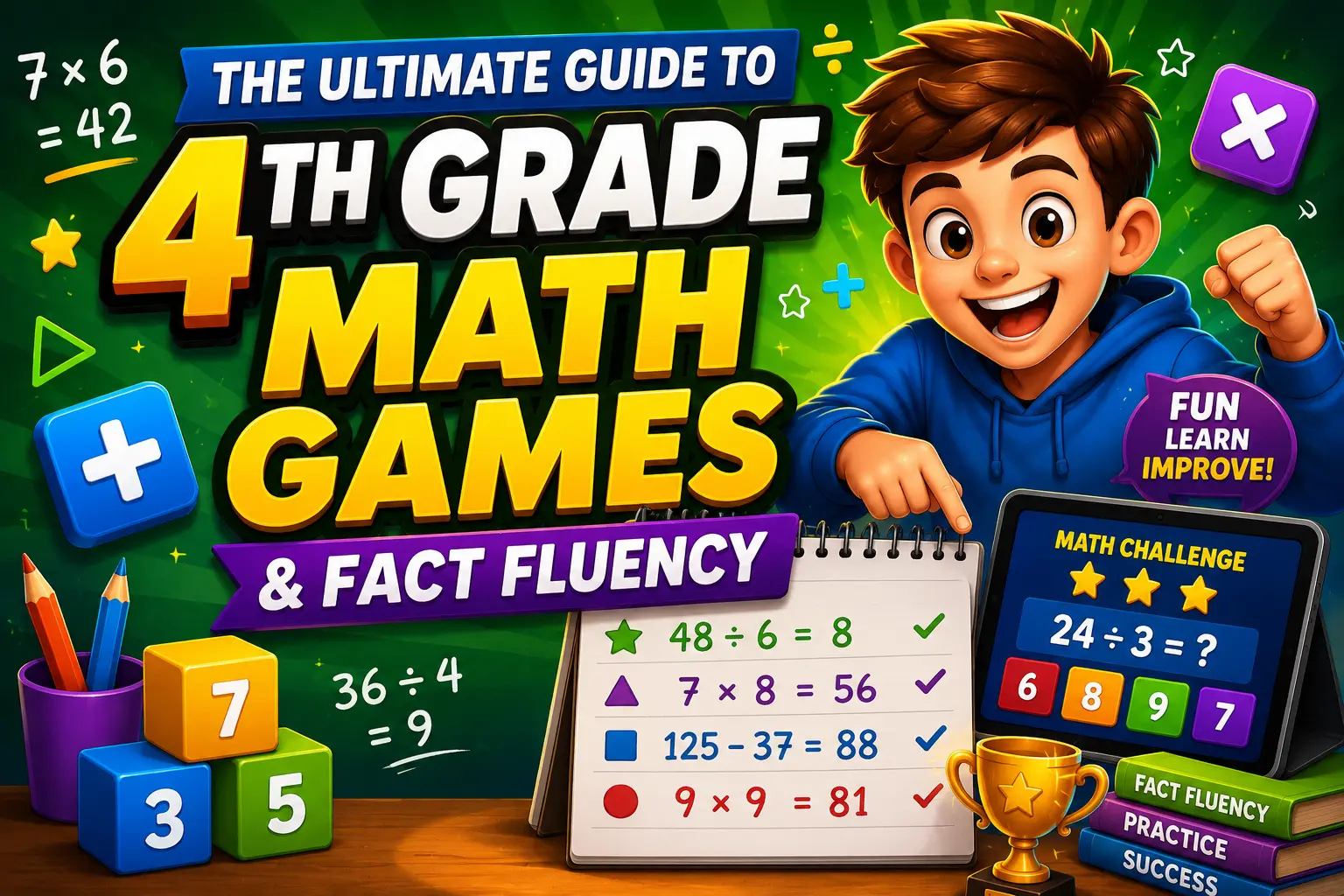
The 4th Grade Math Turning Point: In elementary education, fourth grade is widely recognized as the pivotal year where math shifts from basic single-digit calculation into complex, abstract operations: multi-digit multiplication, long division algorithms, equivalent fractions, and introductory angles. When students lack automatic fact recall (the ability to answer 7 × 8 in under 2 seconds without counting on fingers), their working memory becomes overloaded by multi-step long division.
Research consistently shows that 10 minutes of daily interactive math gamification produces 3x faster fluency acquisition compared to repetitive flashcards or rote worksheets. Below is a comprehensive educator's roadmap to the best 4th-grade math games and implementation routines.
4th Grade Curriculum Focus & Recommended Game Formats
| Core 4th Grade Standard | Key Learning Challenge | Optimal Game Mechanics | Recommended MathTug Game |
|---|---|---|---|
| Multiplication Fact Fluency (0–12) | Struggling with 6x, 7x, 8x, and 9x tables | Competitive 2-Player Tug of War | Math Tug of War (Primary Mode) |
| Multi-Digit Sequencing & Paths | Mental carrying and number patterns | Spatial Arithmetic Grid Navigation | Number Maze (4×4 & 5×5 Grids) |
| Fractions & Equivalence | Confusing numerator/denominator rules | Visual Fraction Bar & Pie Matching | Fraction Frenzy |
| Long Division Foundations | Understanding remainders and inverse tables | Equation Assembly & Factor Hunts | Equation Builder & Prime Patrol |
| Spatial Reasoning & Angles | Directional logic and coordinate mapping | Directional Logic Puzzles | Arrow Puzzle & Math Grid |
1. Mastering Multiplication Fact Fluency Through Play
For fourth graders, multiplication automaticity is the gateway skill. If a student has to pause and mentally count up by 7s to solve 7 × 6, long division problems (e.g., 432 ÷ 7) become overwhelming.
- How Games Help: Games like Math Tug of War create positive, gamified stakes. When kids see the virtual rope pull across the screen, their motivation to recall facts instantly spikes.
- Teacher Strategy: Isolate difficult fact families. Pair students in our 2-Player Games Arena for 5-minute fact battles.
👉 Practice 4th Grade Fact Fluency in Math Tug of War →
2. Demystifying Fractions with Visual Interaction
Fractions are notoriously abstract for 9- and 10-year-olds because a larger denominator (e.g., 1/8) represents a smaller quantity than a smaller denominator (1/4).
- Interactive Solution: Games like Fraction Frenzy and Balance Scale Math allow students to physically visualize and compare fractional pieces before calculating numerical identities.
- Tactile Benefit: Seeing the visual scale tilt in real time bridges the gap between concrete physical objects and abstract symbols.
👉 Play Fraction Frenzy Online →
3. Number Maze: Building Multi-Step Mental Planning
In fourth grade, standard algorithms require students to hold multiple numbers in their working memory simultaneously. Number Maze trains this exact executive function skill by asking players to plan 3 steps ahead across a numerical grid to reach the finish line. 👉 Play Number Maze Grids →
4. Long Division & Factorization: Prime Patrol & Equation Builder
Understanding which numbers are prime (e.g., 17, 23, 29) versus composite is essential for finding least common denominators (LCD) and simplifying fractions. Prime Patrol and Equation Builder train students to spot factorable numbers in an exciting arcade-style format. For printable offline review, explore our 4th Grade Printable Math Worksheets.
A 10-Minute Daily Classroom Routine for 4th Grade Teachers
- Minutes 0–3 (Individual Warm-Up): Students open Chromebooks and solve one 4×4 Number Maze to activate spatial logic and focus.
- Minutes 3–8 (2-Player Duel): Desk partners launch Math Tug of War for a best-of-five multiplication table showdown.
- Minutes 8–10 (Exit Ticket Review): Teacher pulls up a single challenging Equation Builder puzzle on the smartboard for the whole class to solve collaboratively.
Frequently Asked Questions for 4th Grade Teachers & Parents
How much math game time is optimal per day for a 4th grader?
Educational research recommends 10 to 15 minutes of structured gamified math practice per day. Short, frequent sessions build neurological automaticity without causing screen fatigue.
Are these games aligned with elementary math standards?
Yes. All operations, fraction models, and number pattern sequences featured on MathTug are designed to align with standard Grade 3–5 math curriculum benchmarks (operations, algebraic thinking, fractions, and base-ten arithmetic).
Recommended Hands-on Math & Focus Tools
Top-rated learning tools on Amazon that support the strategies in this article:


📥 Get Our Free Classroom Math Puzzles & Worksheets
Enjoyed this guide? Join our educator community and receive weekly printable activities and mental math worksheets.
About the Author: Shubham
Math Educator & Developer
Shubham is a dedicated math educator and software engineer with a passion for gamifying education. He created MathTug to help teachers and parents utilize interactive digital games on smartboards and projectors to make math learning collaborative, active, and stress-free for kids.
Learn more about our educational mission on the About Us page →Enjoyed this post?
Share it with your colleagues or explore more fun ways to teach math on MathTug.
🎮 Play Games