
The Role of Play in Math Learning: What Educational Research Says
Discover what cognitive science and educational research tell us about the power of play in developing math skills, conceptual understanding, and a positive mindset in children.
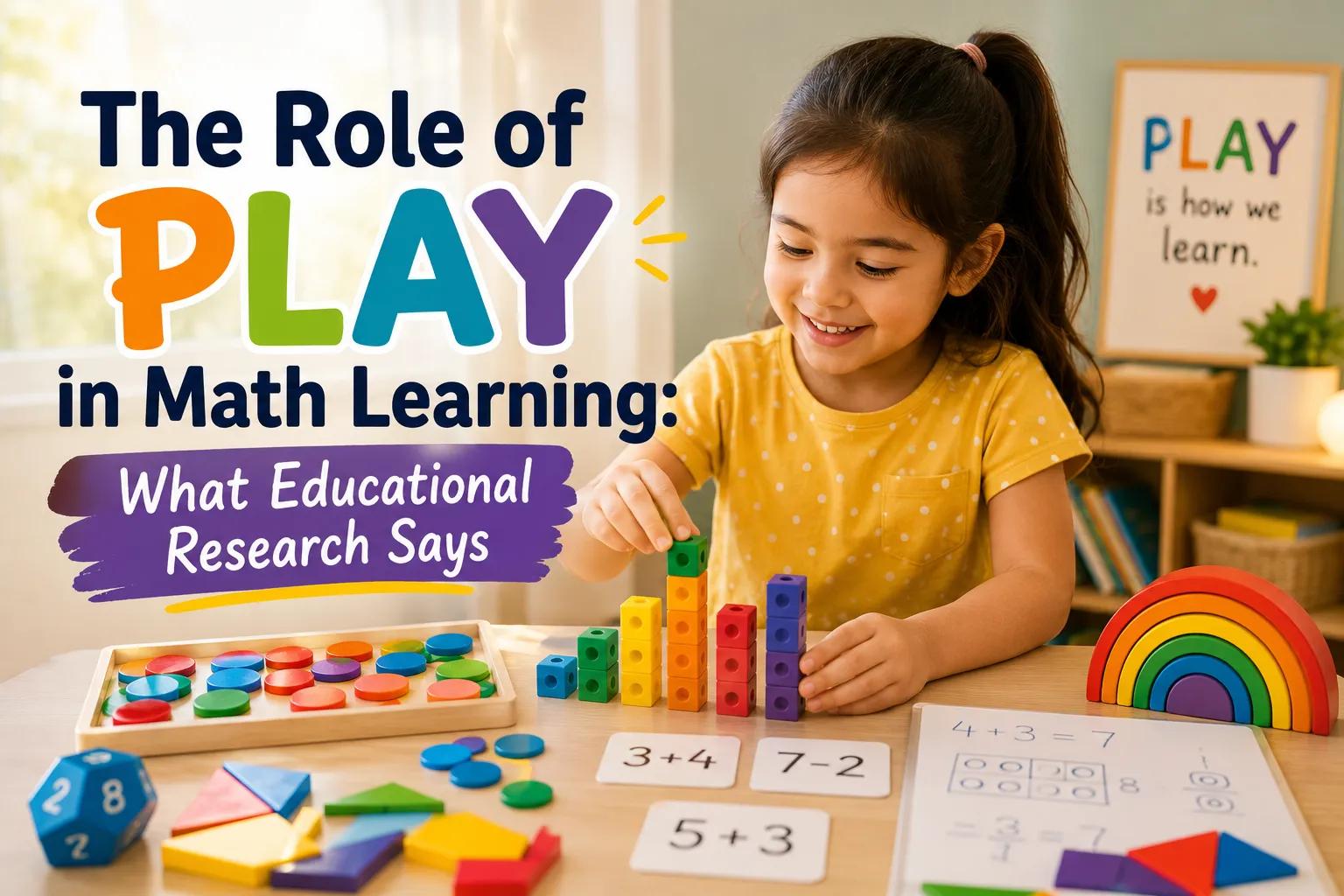
As a math educator, I often have to defend play-based learning. Some parents look at my classroom full of blocks, dice, and screen games and worry that their children are just "playing" instead of doing "real studying."
They believe that learning must be quiet, serious, and slightly uncomfortable to be effective.
However, cognitive science and educational research tell a completely different story.
Decades of research prove that play is not a distraction from learning; it is the brain's most natural and efficient way to process new information.
When children learn math through play, they build deeper conceptual understanding, retain information longer, and develop a healthier attitude toward problem-solving. Here is what the research says about the role of play in mathematics.
1. Play Activates the Brain's Reward System
When children are bored or stressed, their brains release cortisol, a hormone that actually blocks the prefrontal cortex—the area responsible for logical thinking and memory.
- The Neuroscience: Research shows that playful learning triggers the release of dopamine, a neurotransmitter associated with pleasure, motivation, and memory.
- Why it matters: Dopamine acts like a save button in the brain. When a child solves a math puzzle during an exciting game like MathTug, the emotional "win" triggers dopamine, cementing that mathematical rule (like a multiplication fact) in their long-term memory.
2. Play Connects Concrete Experience with Abstract Logic
Swiss psychologist Jean Piaget famously proved that children go through developmental stages where they must interact with the physical world before they can understand abstract logic.
- The Research: Studies on hands-on play (using block towers, playdough, and geometric shapes) show that manipulating objects helps children build mental schemas of space and quantity.
- Why it matters: A child who has played with physical fraction strips or partitioned a playdough circle understands the concept of fractions. When they are later introduced to the abstract symbol
1/4, they can connect it to their physical memory of play, making the symbol make sense.
3. Play Reduces Math Anxiety and Encourages Risk-Taking
One of the biggest obstacles to math achievement is the fear of failure.
- The Research: Stanford researcher Carol Dweck's work on "growth mindset" shows that students who view intelligence as something that can be developed through effort are much more successful than those who believe they are either "smart" or "not."
- Why it matters: Play-based learning is naturally low-stakes. When playing games or solving logic puzzles like Arrow Puzzle, getting a wrong answer is just a cue to try a different strategy. This play environment teaches children that mistakes are valuable sources of data, building the resilience needed to solve difficult algebraic problems.
4. Play Fosters "Guided Play" (The Teacher's Role)
Research shows that while free play is excellent for social skills, "guided play" is the most effective method for learning academic concepts.
- The Research: Guided play is a learning environment where the teacher sets up the game and rules, but the child directs the actions and choices.
- Why it matters: Using structured digital tools like MathTug allows for perfect guided play. The teacher or parent controls the difficulty level and the focus (e.g., multiplication), but the students choose the strategies and work together to solve the puzzles.
Conclusion
The verdict from educational research is clear: play is a powerful catalyst for mathematical learning. When we combine play, physical movement, and interactive technology, we create a learning experience that respects how a child's brain actually works. Let's stop viewing play as the opposite of work, and start embracing it as the ultimate learning tool. Happy playing!
Recommended Hands-on Math & Focus Tools
Top-rated learning tools on Amazon that support the strategies in this article:
📥 Get Our Free Classroom Math Puzzles & Worksheets
Enjoyed this guide? Join our educator community and receive weekly printable activities and mental math worksheets.
About the Author: Shubham
Math Educator & Developer
Shubham is a dedicated math educator and software engineer with a passion for gamifying education. He created MathTug to help teachers and parents utilize interactive digital games on smartboards and projectors to make math learning collaborative, active, and stress-free for kids.
Learn more about our educational mission on the About Us page →Enjoyed this post?
Share it with your colleagues or explore more fun ways to teach math on MathTug.
🎮 Play Games