
The Best Hands-on Math Manipulatives Every Elementary Classroom Needs
Hands-on math manipulatives are essential for concrete learning. Discover the five best physical tools to build a strong mathematical understanding in elementary classrooms.
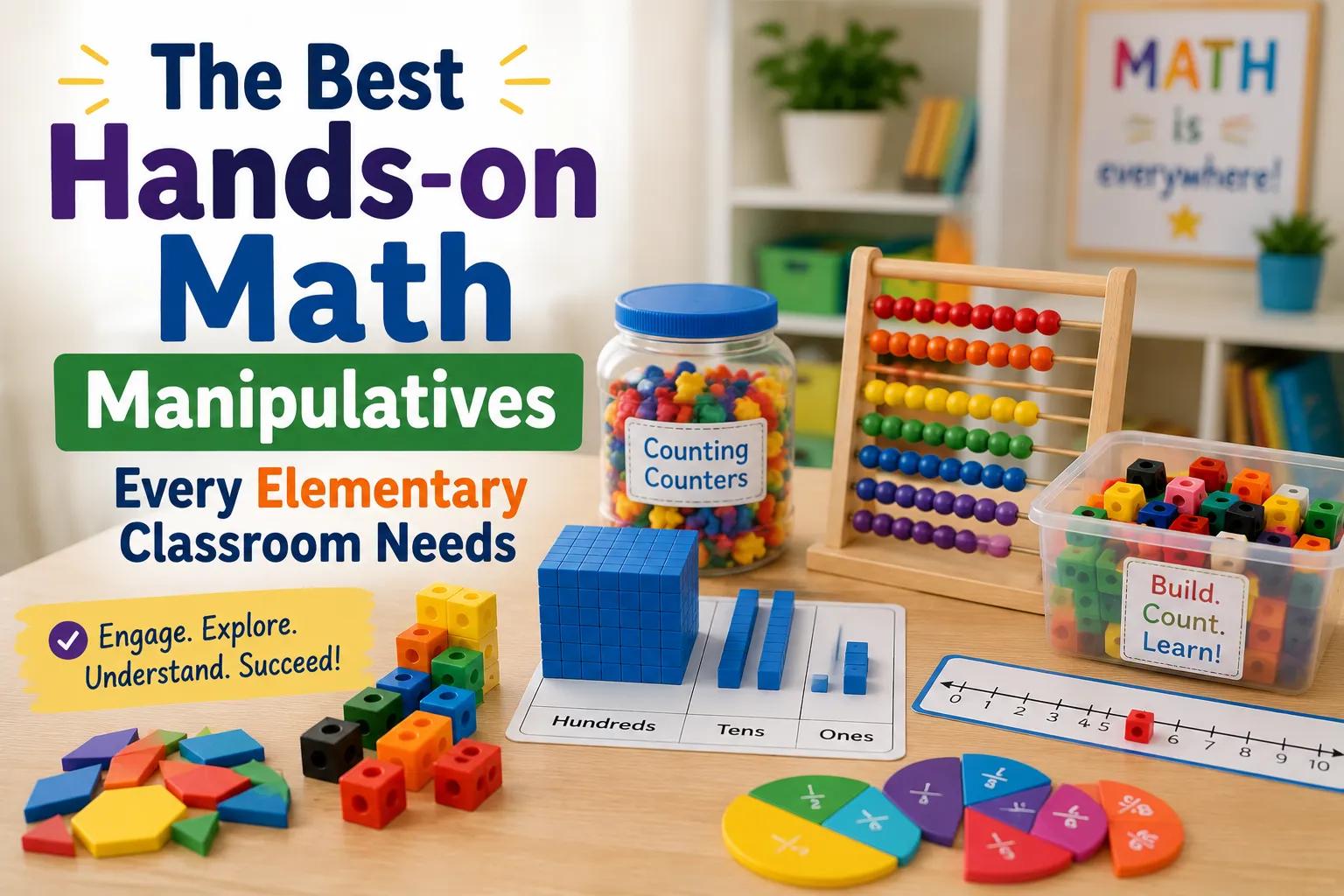
As a math educator, I know that the best learning happens when students can physically touch the concepts they are studying. Before a child can grasp the abstract world of equations, they must build a concrete understanding of numbers and shapes.
This is where math manipulatives come in.
Manipulatives are physical objects—like blocks, shapes, or counters—that help students visualize math concepts. They turn abstract ideas into hands-on learning experiences.
Over the years, my classroom shelves have been filled with various tools. Some are used once a year, while others are dragged out daily.
If you want to build a strong math foundation at school or at home, here are the top five hands-on math manipulatives I recommend for every elementary classroom.
1. Base-10 Blocks
- Best for: Teaching place value, double-digit addition, subtraction, and decimals (Grades K-5)
- What they are: Plastic or wooden blocks consisting of units (ones), rods (tens), flats (hundreds), and cubes (thousands).
Base-10 blocks are the gold standard for place value instruction.
- How to use them: When teaching subtraction with regrouping (like
42 - 18), have students build the number 42 with 4 tens-rods and 2 ones-units. To subtract 8 ones, they must physically exchange one tens-rod for 10 ones-units. - Why I recommend them: They make the concept of "borrowing" or "regrouping" visual and logical. Students can see that the value of the number remains the same; it is just regrouped into different blocks.
2. Pattern Blocks
- Best for: Teaching geometry, spatial reasoning, symmetry, and fractions (Grades K-6)
- What they are: A set of wooden or plastic geometric shapes (green triangles, orange squares, yellow hexagons, etc.) that fit together perfectly.
Pattern blocks are incredibly versatile.
- How to use them: For fractions, you can define the yellow hexagon as "one whole." Students then discover that two red trapezoids make a whole (
1/2), three blue rhombuses make a whole (1/3), and six green triangles make a whole (1/6). - Why I recommend them: They are highly tactile and allow students to explore symmetry and spatial rotation naturally through play and geometry puzzles.
3. Cuisenaire Rods
- Best for: Teaching addition, subtraction, fractions, and early algebra (Grades K-8)
- What they are: Ten colored rectangular rods of varying lengths, where each color represents a specific number from 1 to 10.
Cuisenaire rods are fantastic for helping students visualize number magnitude and algebraic equations.
- How to use them: Place a red rod (length 2) next to a light green rod (length 3). Students will find that their combined length matches a yellow rod (length 5). This visually proves
2 + 3 = 5. - Why I recommend them: Because they do not have markings or numbers printed on them, they force students to focus on the relative sizes and ratios, which builds a strong foundation for fractions and algebraic functions.
4. Double-Sided Counters
- Best for: Counting, probability, addition/subtraction, and negative numbers (Grades K-8)
- What they are: Small circular tokens that are red on one side and yellow on the other.
These simple, inexpensive tokens are a staple in my classroom.
- How to use them: For early addition, toss 6 counters on a table. If 4 land on red and 2 land on yellow, write the equation
4 + 2 = 6. For older students, they are perfect for representing positive (yellow) and negative (red) integers. - Why I recommend them: They are incredibly simple but highly versatile, making them great for probability experiments and basic arithmetic alike.
5. Rekenrek (Arithmetic Rack)
- Best for: Developing number sense, subitizing, and making a 10 (Grades Pre-K to 2)
- What it is: A wooden frame with two rows of 10 beads (5 red and 5 white on each row).
The Rekenrek was invented in the Netherlands and is a powerful tool for early number sense.
- How to use it: Slide beads to represent numbers. The color grouping of 5 red and 5 white helps kids see numbers in relation to 5 and 10. For example, the number 7 is instantly seen as "5 red beads and 2 white beads."
- Why I recommend it: Unlike an abacus, the Rekenrek is designed to help children move away from counting beads one by one and instead see numbers as groups, which is crucial for mental math speed.
Conclusion
Physical manipulatives bridge the gap between concrete objects and abstract math. By providing students with these hands-on tools alongside digital interactive resources like MathTug, you can ensure they build a deep, logical understanding of mathematics. Happy teaching!
Recommended Hands-on Math & Focus Tools
Top-rated learning tools on Amazon that support the strategies in this article:
📥 Get Our Free Classroom Math Puzzles & Worksheets
Enjoyed this guide? Join our educator community and receive weekly printable activities and mental math worksheets.
About the Author: Shubham
Math Educator & Developer
Shubham is a dedicated math educator and software engineer with a passion for gamifying education. He created MathTug to help teachers and parents utilize interactive digital games on smartboards and projectors to make math learning collaborative, active, and stress-free for kids.
Learn more about our educational mission on the About Us page →Enjoyed this post?
Share it with your colleagues or explore more fun ways to teach math on MathTug.
🎮 Play Games