
Mastering Skip Counting: A Teacher's Guide to Fun Strategies
Skip counting is the foundation for multiplication and division. Learn five creative, active, and visual skip counting strategies to help elementary students master this vital skill.
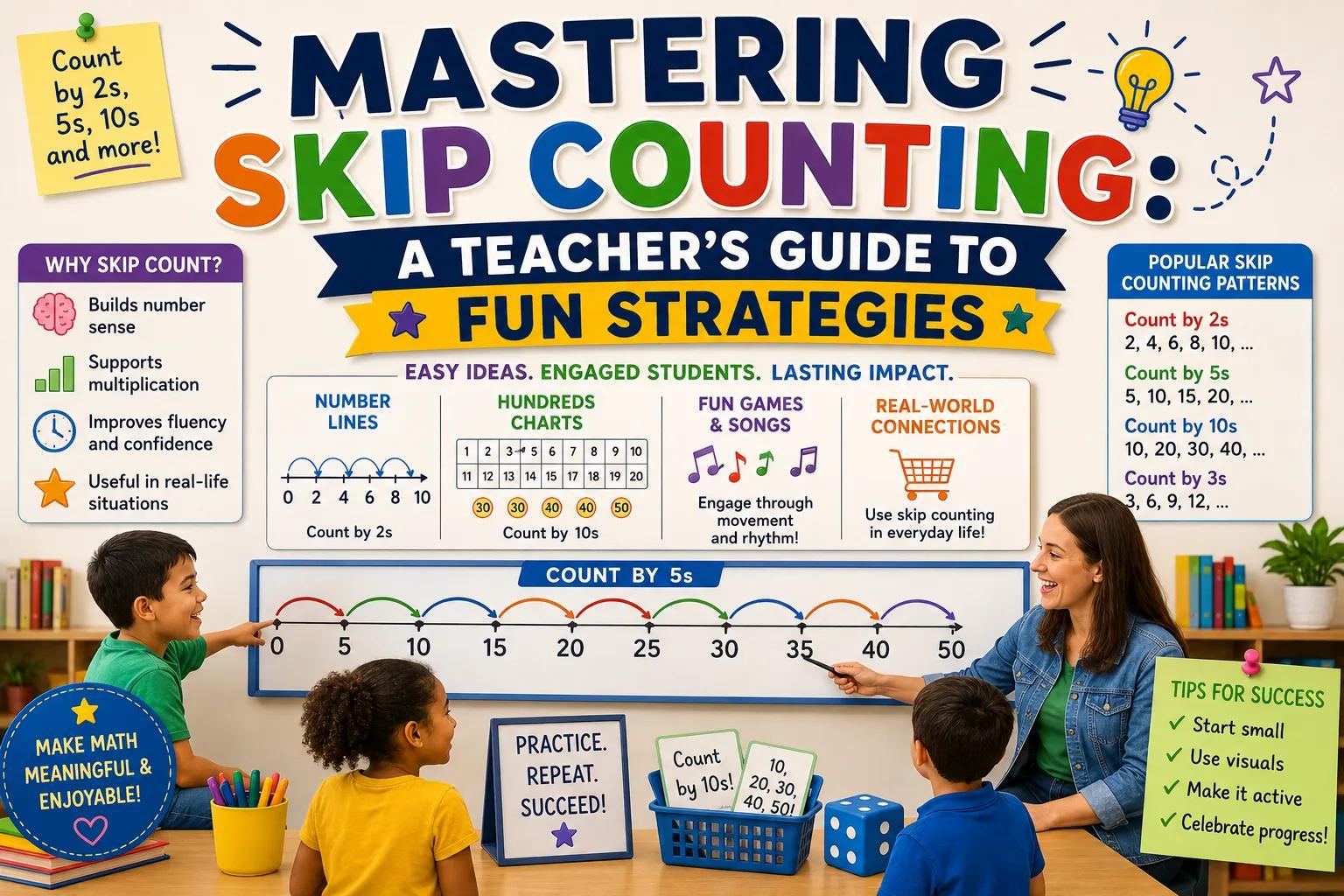
When I introduce multiplication to my students, I rarely start with flashcards. Instead, I look back at a skill they should have started developing in first and second grade: skip counting.
Skip counting is the ability to count by numbers other than one—such as 2s, 5s, 10s, or even 3s and 4s.
As a math educator, I view skip counting as the essential bridge between basic addition and multiplication. If a student can skip count by 3s (3, 6, 9, 12...), they are already performing multiplication without realizing it.
However, reciting number patterns in a monotone voice can quickly bore young learners. To make these patterns stick, we need to make them auditory, physical, and visual.
Here are five of my favorite, classroom-tested skip counting games and strategies.
1. The Hops and Claps Rhythm
- Best for: Auditory and kinesthetic learners (Grades 1-2)
- What you need: Just your students and a bit of floor space.
Math and music have a lot in common. Creating a rhythmic beat helps children memorize number sequences through muscle memory and rhythm.
- How to play: Choose a target number to count by (for example, 5s). Have students stand up. For every number that is not a multiple of 5, they whisper and tap their shoulders (
1, 2, 3, 4). On the multiple of 5, they jump and clap loudly (5!). Then repeat: whisper6, 7, 8, 9and jump/clap10!. - Why I recommend it: The physical movement and sound change highlight the mathematical pattern, making the sequence much easier for auditory learners to recall.
2. Interactive Digital Skip Counting Races
- Best for: Fast-paced practice and smartboard engagement (Grades 1-3)
- What you need: A smartboard running the MathTug game.
Using digital games is a great way to test skip counting speed under pressure.
- How to play: Pull up MathTug on the projector. Navigate to the "Skip Counting" category and select the factor (e.g., count by 2s or 5s). Let the teams compete by matching the correct next number in the sequence.
- Why I recommend it: The visual representation of the game helps students see the direct relationship between skip counting and winning the game, which drives high levels of focus.
3. The Number Maze (Grid Path)
- Best for: Visual pattern recognition (Grades 2-4)
- What you need: A grid puzzle projected on the board or printed on paper.
Understanding skip counting requires recognizing visual patterns on a number grid.
- How to play: Create or project a 100-chart where only certain numbers are revealed. The student must "draw a path" or jump through the grid by following the skip counting pattern (e.g., only stepping on multiples of 3 to exit the maze).
- Why I recommend it: It helps students see the geometric patterns that numbers make on a chart. For instance, counting by 9s creates a perfect diagonal line on a 100-chart, which is an exciting "aha!" moment for visual learners.
4. Ball Toss Circle
- Best for: Building focus and cooperative learning (Grades 1-3)
- What you need: A soft foam ball.
This is a great, low-prep game to fill a spare 5 minutes at the end of a lesson.
- How to play: Have your students stand in a large circle. Start by tossing the ball to a student and saying the starting number (e.g.,
2). That student must catch the ball, say the next number in the pattern (e.g.,4), and toss it to another student, who says6. If someone drops the ball or gets stuck, the class helps them count. - Why I recommend it: It keeps everyone on their toes because no one knows who will be tossed the ball next. It turns skip counting into a team effort.
5. Whisper-Count Relay
- Best for: Transitioning from counting by 1s to skip counting (Grades K-2)
- What you need: A whiteboard and markers.
This game is perfect for students who are just starting to learn the concept of skipping numbers.
- How to play: Write numbers 1 to 20 on the board. Have students take turns coming up to erase the "in-between" numbers, leaving only the skip counting numbers. For example, to count by 2s, they erase
1, 3, 5, 7...so only2, 4, 6, 8...remain. - Why I recommend it: It visually demonstrates what "skipping" actually means. Seeing the numbers disappear helps children understand that they are skip-counting by omitting the odd numbers.
My Expert Tips for Teaching Skip Counting
- Start with 10s and 5s: These are the easiest patterns for children to recognize because they align with our fingers and money (dimes and nickels).
- Don't Forget to Start at Odd Numbers: Once students can count
2, 4, 6, 8..., challenge them by starting at an odd number, like1, 3, 5, 7...or even starting at a random number like13and counting by 5s (18, 23, 28...). This builds true number flexibility. - Connect to Real Life: Always connect skip counting to real-world objects. Count pairs of shoes by 2s, packs of crayons by 8s, or clock minutes by 5s.
Conclusion
Skip counting is not just a rote memorization task; it is the building block of algebraic thinking and multiplication. By incorporating active rhythms, circle games, and interactive tools like MathTug, you can help your students master these patterns while keeping them laughing and engaged. Try one of these strategies today!
Recommended Hands-on Math & Focus Tools
Top-rated learning tools on Amazon that support the strategies in this article:
📥 Get Our Free Classroom Math Puzzles & Worksheets
Enjoyed this guide? Join our educator community and receive weekly printable activities and mental math worksheets.
About the Author: Shubham
Math Educator & Developer
Shubham is a dedicated math educator and software engineer with a passion for gamifying education. He created MathTug to help teachers and parents utilize interactive digital games on smartboards and projectors to make math learning collaborative, active, and stress-free for kids.
Learn more about our educational mission on the About Us page →Enjoyed this post?
Share it with your colleagues or explore more fun ways to teach math on MathTug.
🎮 Play Games