
Making Multiplication Visual: Interactive Games for 3rd Graders
Rote memorization of multiplication tables can frustrate 3rd graders. Discover five visual and interactive games that build a deep conceptual understanding of multiplication.
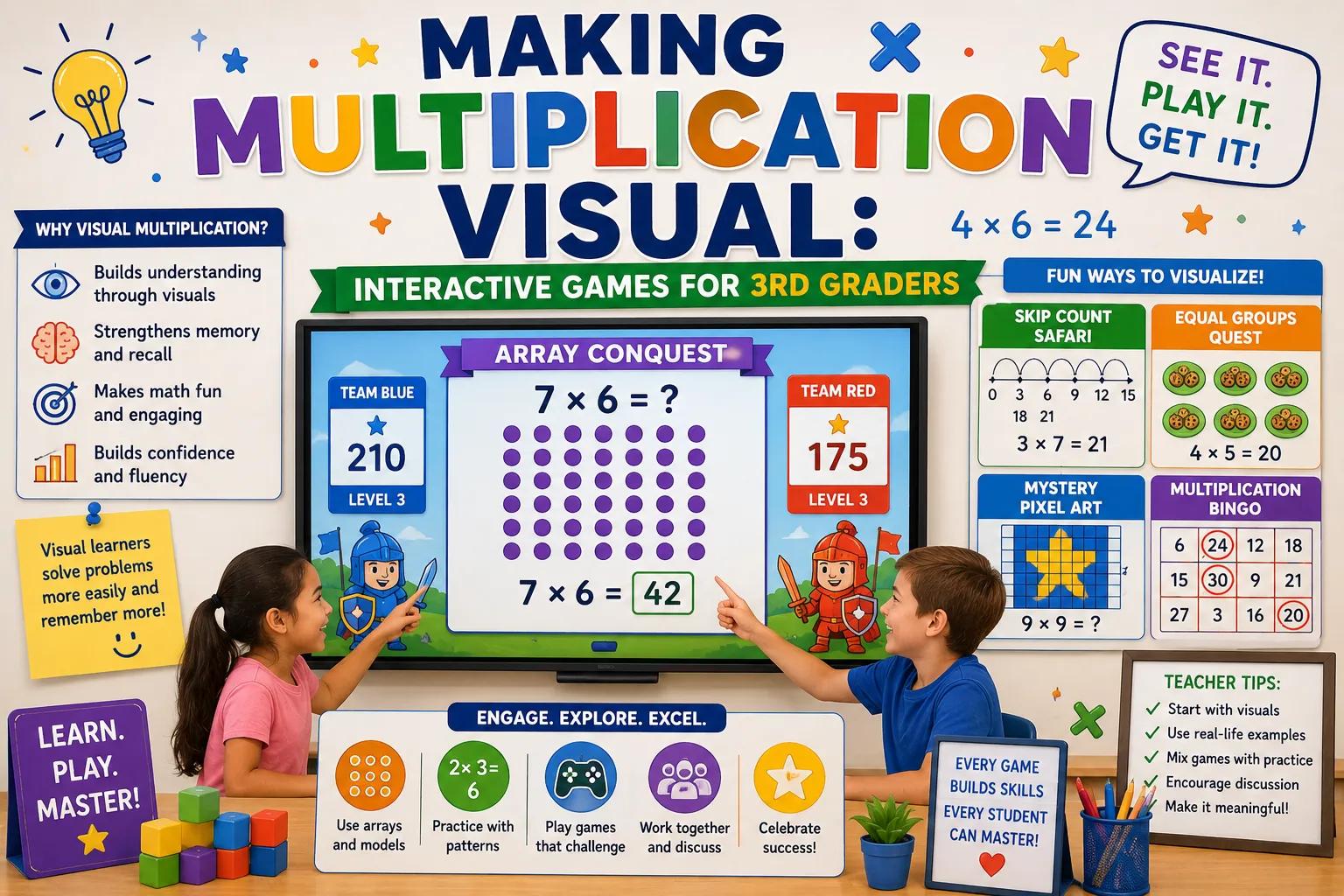
Third grade is a pivotal year for young mathematicians. It is the year they transition from addition and subtraction into the world of multiplication and division.
Historically, this transition has been marked by fear—specifically, the fear of timed multiplication tests and endless flashcard drills.
As a math teacher, I see many third graders shut down when they are forced to memorize facts they do not understand. Multiplication shouldn't just be about speed; it must be about comprehension.
Before we ask kids to remember that 6 x 7 = 42, we must ensure they can visualize why it equals 42. By using visual arrays, equal groups, and interactive games, we can make multiplication intuitive and fun.
Here are five visual multiplication games that I recommend for third-grade classrooms and homes.
1. The Array City Project
- Best for: Understanding multiplication as rows and columns (Grade 3)
- What you need: Grid paper, construction paper, and markers. Download our Free Grid Math Worksheets to get started.
An array (a grid of rows and columns) is the single most important visual model for multiplication. It connects arithmetic directly to geometry and area.
- How to play: Have students create a "city" of skyscrapers using grid paper. Each building represents a multiplication problem. For example, a building that is 5 blocks wide and 6 blocks tall is a
5 x 6building. Students draw windows in the grid cells to count the total area (30 windows). - Why I recommend it: It turns an abstract math problem into a creative art project. Students physically draw the rows and columns, cementing the concept that multiplication is about dimensions.
2. Interactive Digital Multiplication Battles
- Best for: Fast recall and team play (Grade 3)
- What you need: A smartboard or projector running the MathTug Tug of War game.
Once students understand the concept of multiplication, they need to build speed. Using cooperative screen games in our Classroom Hub helps them practice without the stress of individual pressure. 👉 Play Multiplication Tug of War Now →
- How to play: Open MathTug on the projector and select the "Multiplication Tables" category. Split the class into two teams. Students must solve multiplication equations to pull the rope.
- Why I recommend it: The team format encourages peer-to-peer discussion. When a student sees
4 x 8, they can quickly discuss with their team: "That's four groups of eight, or double-double eight!" which builds math talking skills. Also explore our 2-Player Games Arena.
3. Circles and Stars
- Best for: Understanding multiplication as "equal groups" (Grade 3)
- What you need: A pair of dice, paper, and crayons.
This is a classic classroom game that perfectly visualizes the equation: number of groups x size of groups.
- How to play: A student rolls two dice. The first die tells them how many circles to draw on their paper (the groups). The second die tells them how many stars to draw inside each circle (the size of the groups). The student then writes the equation. If they roll a 3 and a 4, they draw 3 circles with 4 stars in each, writing
3 x 4 = 12. - Why I recommend it: It prevents the common mistake of confusing
3 x 4with3 + 4. Drawing the circles and stars makes the "groups of" concept concrete.
4. Block Out (Grid Conquest)
- Best for: Connecting multiplication to area (Grade 3)
- What you need: Grid paper, two dice, and two different colored markers.
This is a highly strategic, two-player game that helps kids visualize how multiplication arrays cover space. Also try our digital Math Grid Puzzle online.
- How to play: Player 1 rolls two dice (e.g., 2 and 5) and colors in an array of that size (
2 x 5 = 10 blocks) anywhere on the grid paper, writing the equation inside. Player 2 does the same with their color. Players take turns until the grid is full. The player who covers the most blocks wins. - Why I recommend it: It teaches spatial reasoning. Students must plan where to place their arrays, helping them see how different shapes (like
2 x 6vs.3 x 4) cover the same amount of area.
5. Multiplication Card War
- Best for: Daily practice and homework replacement (Grade 3)
- What you need: A standard deck of playing cards (face cards removed).
This is a quick game parents can play at home to replace boring homework sheets.
- How to play: Deal the cards evenly. Both players flip over their top card. The first player to multiply the two numbers together and shout out the correct product wins the cards.
- Why I recommend it: It replaces the stress of timed worksheets with the excitement of a card game. Because it is fast-paced, kids get high-repetition practice in a short amount of time.
My Strategy for Teaching Multiplication Facts
When helping students memorize their tables, I recommend teaching them in this strategic order, rather than numerical order:
- The 0s and 1s: The easiest rules (identity and zero property).
- The 2s, 5s, and 10s: Connected to skip counting and familiar patterns. (Practice in Skip Count Duel).
- The 4s and 8s: Taught as "double" and "double-double" strategies (e.g.,
4 x 6is double2 x 6). - The 3s, 6s, and 9s: Patterns with finger tricks and rhythms.
- The 7s and 8s: The hardest facts, which are solved by breaking them into smaller, known facts (e.g.,
7 x 6is(5 x 6) + (2 x 6)). Learn more in our Multiplication Fact Recall Guide.
Conclusion
Multiplication is a cornerstone of elementary math. By keeping it visual and using interactive tools like Math Tug of War, we can ensure that our third graders build a strong, anxiety-free foundation. Try one of these games today to help your students see the beauty in numbers!
Recommended Hands-on Math & Focus Tools
Top-rated learning tools on Amazon that support the strategies in this article:
📥 Get Our Free Classroom Math Puzzles & Worksheets
Enjoyed this guide? Join our educator community and receive weekly printable activities and mental math worksheets.
About the Author: Shubham
Math Educator & Developer
Shubham is a dedicated math educator and software engineer with a passion for gamifying education. He created MathTug to help teachers and parents utilize interactive digital games on smartboards and projectors to make math learning collaborative, active, and stress-free for kids.
Learn more about our educational mission on the About Us page →Enjoyed this post?
Share it with your colleagues or explore more fun ways to teach math on MathTug.
🎮 Play Games