
Interactive Ways to Teach Fractions: From Manipulatives to Digital Games
Fractions can be notoriously difficult for elementary students. Learn five interactive, visual strategies using physical manipulatives and digital games to make fractions click.
In my years of teaching math, I have noticed a common trend: fractions are often the exact point where many students start to lose their confidence in math.
Up until fractions are introduced, numbers have behaved predictably. Two is bigger than one, and three is bigger than two. But suddenly, we introduce fractions, and 1/8 is smaller than 1/4.
This cognitive shift can confuse elementary students if we only teach them fractions using abstract symbols on a worksheet.
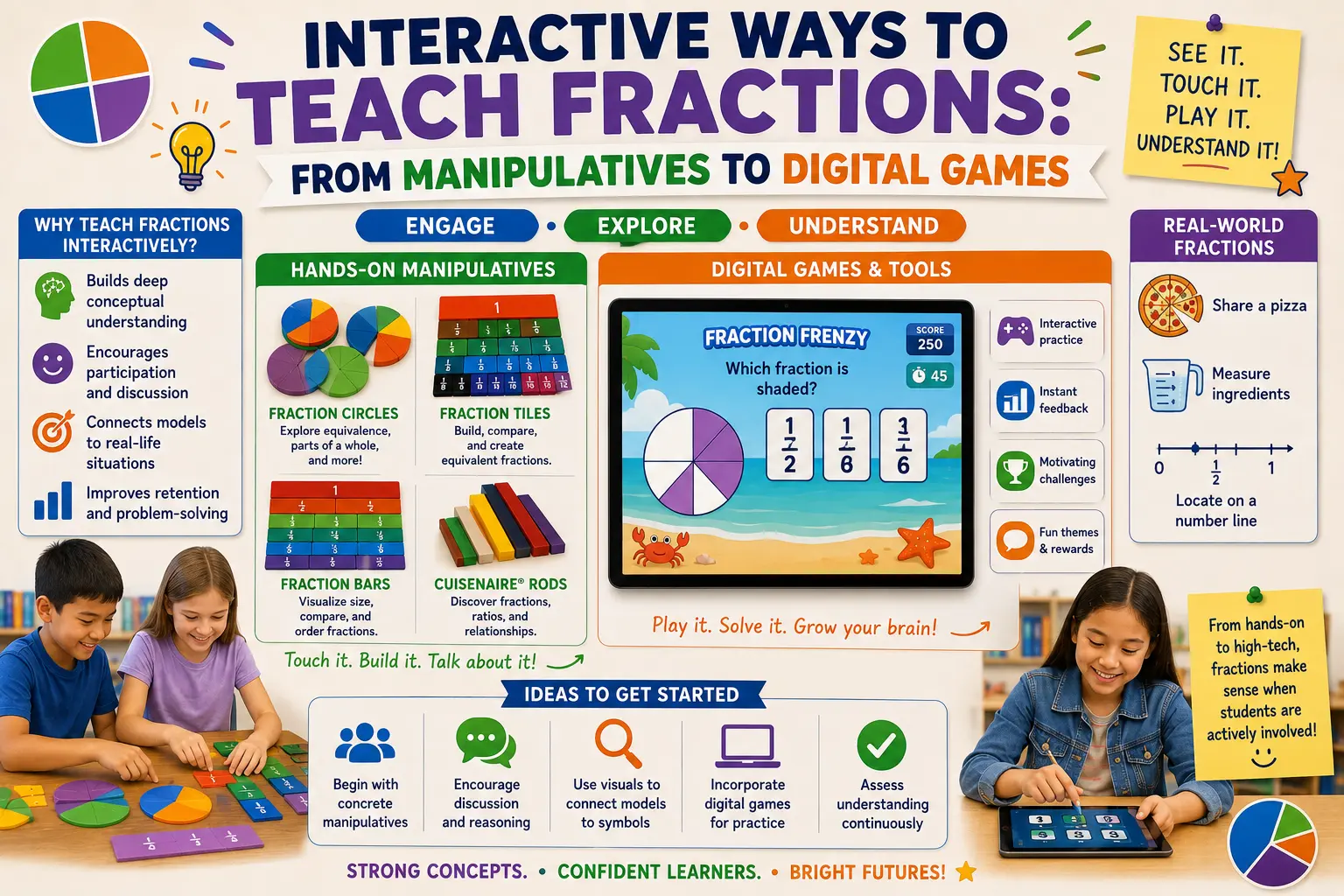
To help students understand fractions, we must make them tangible. We need to let them touch, slide, compare, and play with fractional parts. Here are five of my favorite interactive ways to teach fractions using both physical manipulatives and digital tools.
1. DIY Fraction Strips
- Best for: Understanding equivalent fractions and comparing sizes (Grades 2-4)
- What you need: Colored construction paper, scissors, and markers.
Fraction strips are a classic visual aid that helps students see how different fractional parts fit together to make a whole.
- How to play: Give students five strips of colored paper of equal length. Keep the first strip whole (
1). Cut the second strip in half (1/2). Cut the third into fourths (1/4), the fourth into eighths (1/8), and the fifth into thirds (1/3). Have students label each piece and slide them next to each other to find equivalencies (like seeing that two1/4strips are the exact same length as one1/2strip). - Why I recommend it: Physically folding and cutting the paper helps students connect the division of the paper to the denominator of the fraction.
2. Interactive Digital Fraction Battles
- Best for: Identifying fractions of a whole and visual recall (Grades 3-5)
- What you need: A smartboard running the MathTug game.
Once students understand the basics of fractions, they need to practice recognizing them quickly in different shapes.
- How to play: Project the MathTug game on the smartboard and navigate to the "Fractions" category. Teams compete by identifying the fraction represented by the shaded parts of circles or rectangles.
- Why I recommend it: The game shows fractions in a variety of visual orientations, which prevents students from only recognizing fractions in a standard circle "pizza" format.
3. Fraction Pizza Party (Playdough Math)
- Best for: Understanding parts of a whole and partitioning (Grades 1-3)
- What you need: Playdough, plastic knives, and paper plates.
Using playdough adds a tactile, sensory element to the math lesson, which is highly engaging for younger students.
- How to play: Have students roll out playdough "pizzas" on paper plates. Call out instructions: "Cut your pizza into halves. Now, put pepperoni on 1/2 of your pizza." or "Cut it into fourths. Remove 3/4 of the pizza."
- Why I recommend it: If a student makes a mistake cutting their playdough, they can simply roll it back into a ball and try again. This reduces the fear of making mistakes and keeps the lesson stress-free.
4. LEGO Fraction Towers
- Best for: Understanding fractions of a set (Grades 3-5)
- What you need: Standard LEGO or building blocks of different colors.
Fractions of a set (like "what fraction of these blocks are red?") is often harder for kids to understand than fractions of a single object (like a pizza).
- How to play: Give students a pile of LEGO blocks of different colors. Ask them to build a tower of 10 blocks. Then, ask them to write the fraction for each color in their tower (e.g., if the tower has 4 red blocks, 3 blue blocks, and 3 green blocks, the red fraction is
4/10). - Why I recommend it: Building towers lets students physically separate and group the blocks, making the relationship between the part (red blocks) and the whole (the entire tower) visual and clear.
5. The Number Line Hop
- Best for: Understanding fractions as numbers and locating them on a scale (Grades 3-5)
- What you need: Painter's tape on the floor.
Students often forget that a fraction is an actual number that lives on a number line, not just a shaded shape.
- How to play: Tape a long line on the floor. Mark
0at one end and1at the other. Mark the middle as1/2. Give students cards with different fractions (like1/4,3/4,2/3, or5/8) and have them physically stand on the spot where they think their fraction belongs on the line. - Why I recommend it: It builds a strong understanding of fraction magnitude and helps students learn how to estimate values between 0 and 1.
My Best Tip for Fraction Success
When introducing fractions, avoid using the mathematical terms "numerator" and "denominator" on day one. Instead, use student-friendly language:
- The Bottom Number (Denominator): Tell them, "This is the total number of equal pieces we cut the whole into."
- The Top Number (Numerator): Tell them, "This is the number of pieces we are talking about, eating, or shading." Once they understand the concept, you can easily introduce the formal vocabulary.
Conclusion
Fractions don't have to be the point where math gets scary. By using tactile manipulatives, sensory playdough, and visual digital games like MathTug, you can demystify fractions and build a strong mathematical foundation. Try one of these strategies in your classroom tomorrow!
Recommended Hands-on Math & Focus Tools
Top-rated learning tools on Amazon that support the strategies in this article:
📥 Get Our Free Classroom Math Puzzles & Worksheets
Enjoyed this guide? Join our educator community and receive weekly printable activities and mental math worksheets.
About the Author: Shubham
Math Educator & Developer
Shubham is a dedicated math educator and software engineer with a passion for gamifying education. He created MathTug to help teachers and parents utilize interactive digital games on smartboards and projectors to make math learning collaborative, active, and stress-free for kids.
Learn more about our educational mission on the About Us page →Enjoyed this post?
Share it with your colleagues or explore more fun ways to teach math on MathTug.
🎮 Play Games