
How to Set Up a Fun "Math Station" at Home: A Guide for Parents
Discover how to set up a dedicated, engaging "math station" at home to encourage independent math exploration, hands-on play, and learning for your children.
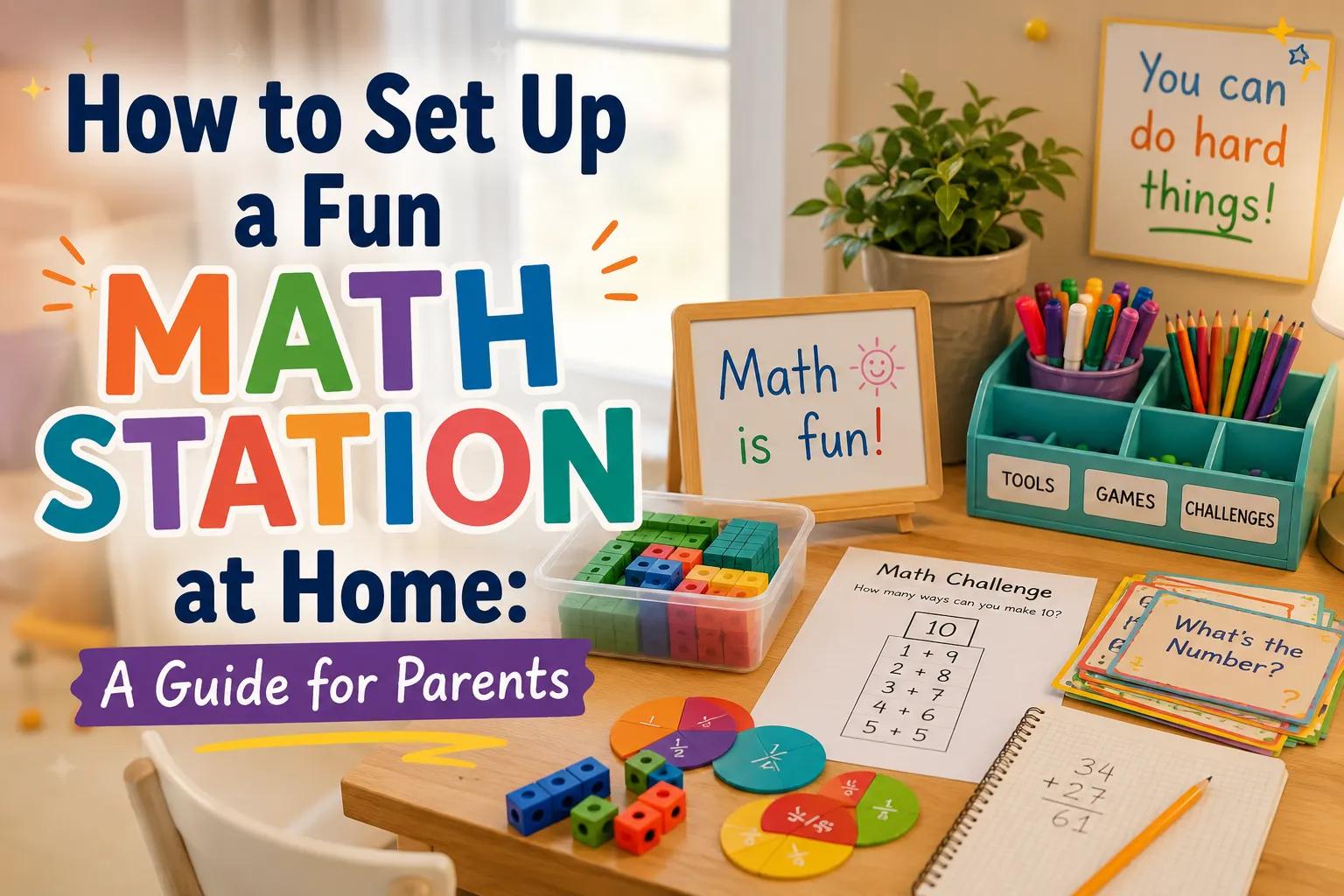
As a math educator, I know that children learn best when their environment invites curiosity. In classrooms, teachers use "centers" or "stations" dedicated to specific subjects.
These stations are designed to let students explore materials, solve puzzles, and learn independently.
So, why not bring this concept home?
Setting up a dedicated "Math Station" at home is one of the easiest ways to encourage your child to explore mathematical concepts through play. It doesn't require a large budget or a dedicated room—just a small corner, a shelf, or even a plastic bin filled with the right tools.
Here is a step-by-step guide for parents to create a fun, engaging math station at home.
Step 1: Choose the Right Location
Your math station should be in a place where your child feels comfortable and can work without constant distraction, but it should also be easily accessible.
- The Kitchen Table Corner: A small basket on the dining table that can be pulled out easily.
- A Dedicated Shelf: A low shelf in the living room or playroom where materials are kept at your child's eye level.
- A Portable Bin: A plastic bin with a handle that can be carried to the couch, the floor, or even outdoors.
Step 2: Stock Up on Hands-on Manipulatives
To make the station engaging, it must be tactile. Stock it with physical objects that invite touching and building:
- Counters: Glass gems, colored buttons, or plastic tokens for counting and sorting.
- Geometric Shapes: Pattern blocks or Tangrams for building shapes and exploring symmetry.
- Measuring Tools: A ruler, a tape measure, and a kitchen scale to measure length and weight.
- Dice and Playing Cards: Crucial props for running quick math games.
Step 3: Add Logic Puzzles and Brain Teasers
Math is more than arithmetic; it is logic. Include materials that challenge their problem-solving skills:
- Sudoku Puzzles: Printed kid-friendly Sudoku grids.
- Logic Cards: Brain teasers or riddles.
- Spatial Games: Standard block puzzles, rubik's cubes, or links to digital logic grids like Arrow Puzzle on a tablet.
Step 4: Make it a Digital Hub
If you allow screen time, dedicate a tablet or laptop at the math station specifically for educational games.
- Bookmarks: Set up bookmarks to high-quality, ad-free, and educational game sites.
- Cooperative Play: Bookmark MathTug so your child can play a quick round of tug-of-war math to practice their math facts in a fun, low-stress way.
Step 5: Keep it Dynamic (Rotate Materials)
The biggest mistake parents make is setting up a station and leaving it exactly the same for months. If the materials never change, your child will lose interest.
- Weekly Themes: Change the theme of the station periodically. One week can be "Fraction Week" (stocked with fraction strips and playdough), and the next can be "Geometry Week" (stocked with pattern blocks and tangram cards).
- Introduce New Challenges: Add a "Problem of the Week" on a mini whiteboard at the station, and reward your child with praise or a small treat when they solve it.
Conclusion
A math station at home turns math from a structured, stressful subject into a natural, playful exploration. By dedicating a small space, stocking it with hands-on tools, and providing engaging digital games like MathTug, you can foster a lifelong love for mathematical thinking in your child. Set up your home math station today!
Recommended Hands-on Math & Focus Tools
Top-rated learning tools on Amazon that support the strategies in this article:
📥 Get Our Free Classroom Math Puzzles & Worksheets
Enjoyed this guide? Join our educator community and receive weekly printable activities and mental math worksheets.
About the Author: Shubham
Math Educator & Developer
Shubham is a dedicated math educator and software engineer with a passion for gamifying education. He created MathTug to help teachers and parents utilize interactive digital games on smartboards and projectors to make math learning collaborative, active, and stress-free for kids.
Learn more about our educational mission on the About Us page →Enjoyed this post?
Share it with your colleagues or explore more fun ways to teach math on MathTug.
🎮 Play Games