
How to Run a Math Tug-of-War Competition in Your Classroom
A complete step-by-step guide for teachers to organize and run an exciting math tug-of-war tournament in their classroom to improve mental math speed and team collaboration.
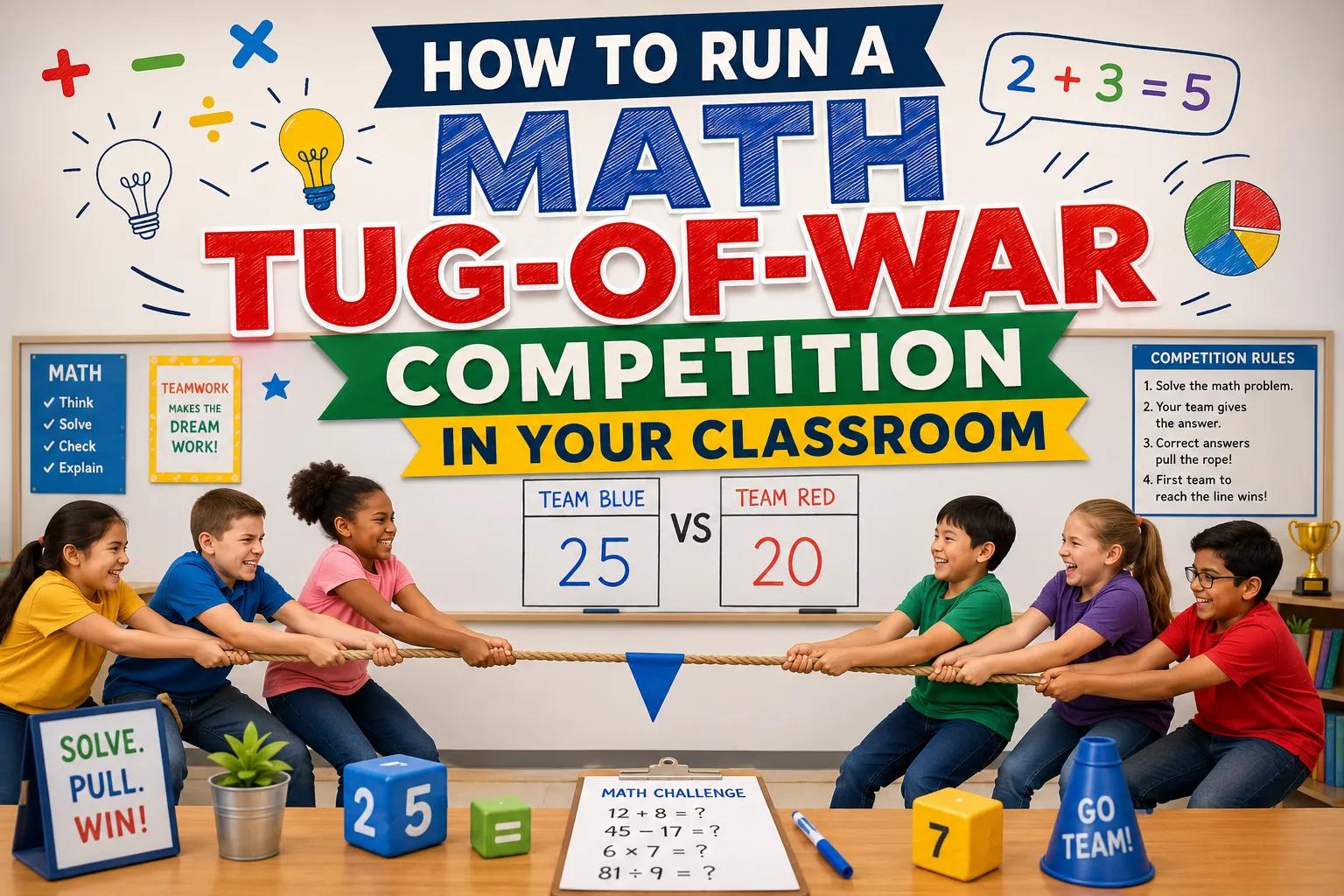
Introduction Classroom competitions are a powerful tool for learning. When students work in teams to solve academic challenges, their motivation spikes, and math anxiety melts away. One of the most effective and exciting ways to channel this energy is by running a Math Tug-of-War Competition.
By transforming standard math problems into a virtual battle of strength, you can turn a quiet classroom into a cheering, collaborative learning space. In this guide, we will walk you through exactly how to set up, run, and manage a math tug-of-war game in your classroom.
Step 1: Prepare Your Tech and Classroom Layout
Before you begin the game, ensure your classroom environment is ready for action.
- The Big Screen: Open the MathTug Game on your computer and project it onto a smartboard, interactive whiteboard, or a large screen at the front of the room.
- Divide the Classroom: Split your students into two balanced teams. You can divide them by rows (Left side vs. Right side), pull names from a jar, or create mixed-ability teams so that the competition remains fair.
- Assign Colors: Let one team represent the Red Team and the other represent the Blue Team, matching the players on the screen.
Step 2: Choose the Right Difficulty Level
To keep all students engaged, the questions must match their current learning goals. Adjust the settings before starting:
- Kindergarten & 1st Grade: Select Basic Counting or Simple Addition (up to 10).
- 2nd & 3rd Grade: Choose Addition/Subtraction and Skip Counting.
- 4th & 5th Grade: Select Multiplication & Division or Fractions.
- Middle School (6th Grade+): Go for Order of Operations (PEMDAS) or Prime Numbers.
Step 3: Establish the Rules of Play
To prevent chaos and ensure everyone gets a turn to think, set clear ground rules:
- No Shouting Out: Only the designated "active player" or the group whose turn it is can answer. Shouting out answers for the other team results in a penalty!
- Rotate Players: Have students take turns coming up to the smartboard to click the answer, or nominate a "scribe" who inputs the answers while team members discuss.
- Double Check: Encourage team members to whisper and check each other’s calculations before submitting their answer.
Step 4: Run the Competition (Gameplay Formats)
Depending on your class time, you can run the competition in two different formats:
Format A: The Quick Battle (Best for Warm-ups)
- Play a single round of MathTug (usually taking 3-5 minutes).
- Use it as a morning hook or a transition activity after recess to help students settle down and focus their minds.
Format B: The Grand Tournament (Best for Friday Fun)
- Split the class into four smaller teams (e.g., Team A, B, C, and D).
- Create a simple tournament bracket on the whiteboard.
- Run semi-final matches (Team A vs. Team B, Team C vs. Team D) and then a championship round to declare the ultimate "MathTug Champions."
Step 5: Incorporate Post-Game Reflection
The game doesn’t end when a team gets pulled across the line. The best learning happens when you review mistakes:
- Analyze the Tough Questions: If a team loses ground because of a difficult fraction or multiplication problem, pause the game.
- Write it out: Solve the problem together on the whiteboard. Show the students why the wrong answer was tempting and how to find the correct path.
- Reward Effort, Not Just Winning: Give stickers or praise to students who showed great teamwork, helped a teammate calculate, or explained a difficult problem to their peers.
Conclusion
A math tug-of-war competition is more than just a game; it is an active learning strategy that builds community, reviews core curriculum concepts, and boosts mental math speed. Try running a match in your classroom this week and watch your students engage with math like never before!
Recommended Hands-on Math & Focus Tools
Top-rated learning tools on Amazon that support the strategies in this article:
📥 Get Our Free Classroom Math Puzzles & Worksheets
Enjoyed this guide? Join our educator community and receive weekly printable activities and mental math worksheets.
About the Author: Shubham
Math Educator & Developer
Shubham is a dedicated math educator and software engineer with a passion for gamifying education. He created MathTug to help teachers and parents utilize interactive digital games on smartboards and projectors to make math learning collaborative, active, and stress-free for kids.
Learn more about our educational mission on the About Us page →Enjoyed this post?
Share it with your colleagues or explore more fun ways to teach math on MathTug.
🎮 Play Games