
How to Help Your Child with Math Homework Without the Stress
Math homework doesn't have to end in tears. Learn five practical, teacher-approved tips for parents to help their children with math homework while reducing stress and building confidence.
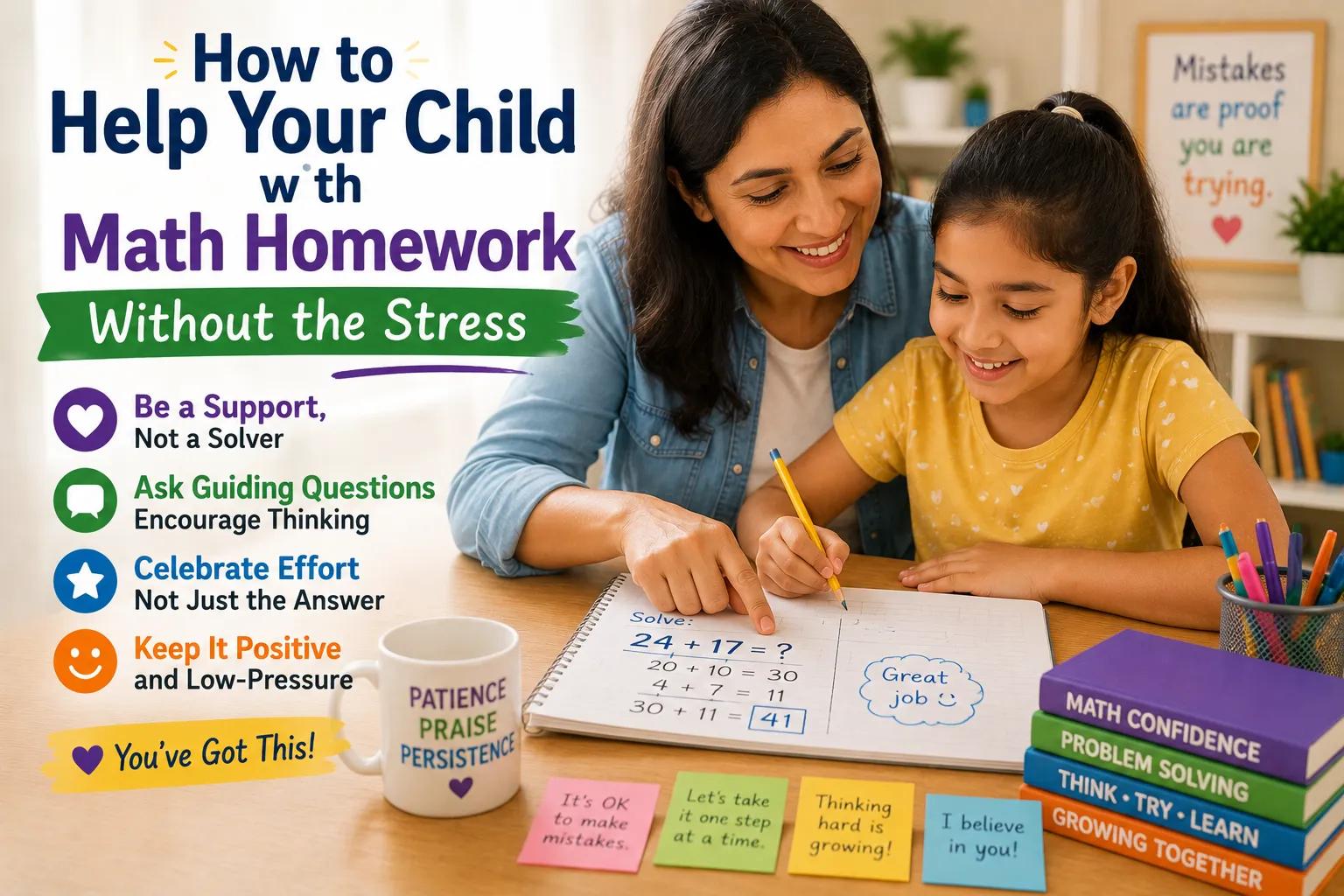
As a math teacher, parents often call me in frustration.
They say: "I want to help my child with their math homework, but they teach it so differently now! I don't understand 'common core math' and it always ends in tears and stress at the kitchen table."
I completely understand this frustration. Math homework has changed from the simple, repetitive drills we did as kids.
Today's math focuses on conceptual understanding, showing multiple strategies, and explaining the reasoning behind the math.
In my experience, the goal of homework isn't to get a perfect score; it is to build confidence and show the teacher what the child can do.
Here are my top five teacher-approved tips to make math homework sessions stress-free, collaborative, and successful.
1. Ask "Process Questions" Instead of Giving Answers
When your child gets stuck, the temptation is to say: "Here is how you do it, just write down 12."
- The Problem: Giving the answer solves the immediate problem, but it doesn't teach the concept.
- The Solution: Ask guided questions that help them find the path themselves:
- "What is this problem asking us to do?"
- "What is the first step you did in class today?"
- "Can you draw a picture or use counters to show me this problem?"
- "What do you think is a reasonable estimate for the answer?"
2. Embrace Mistakes as Learning Data
Children are often terrified of writing a wrong answer because they associate mistakes with failure.
- Normalize Mistakes: Teach your child that mistakes are just part of the learning process. If they write
4 + 3 = 8, don't immediately correct them. - Analyze the Mistake: Say: "Let's check that on our fingers or draw dots. Let's see how we got to 8." When they find their own mistake, they learn how to self-correct, which is a vital mathematical skill.
3. Don't Fight the "New Math" (Common Core)
Parents often get frustrated because the school's math methods (like area models or number bonds) seem longer and more complicated than standard algorithms.
- Why it's taught: These new methods are designed to build a strong conceptual understanding. For example, using an area model for double-digit multiplication visually explains why the standard multiplication algorithm works.
- Keep an Open Mind: If your child is using a strategy you don't know, ask them to teach it to you: "I don't know this number bond method. Can you be the teacher and explain it to me?" Teaching a concept is one of the best ways for a child to master it.
4. Keep Homework Sessions Short and Structured
Frustration spikes when children are tired, hungry, or forced to sit for too long.
- The Timer Strategy: Set a timer for 15-20 minutes. Tell your child: "We are going to focus on math for just 15 minutes, and then we will take a break."
- Communicate with the Teacher: If your child works diligently for 20 minutes and is still not finished because the homework is too difficult, write a note to the teacher: "We worked hard for 20 minutes but got stuck on question 4. We stopped here to avoid frustration." Any good teacher will appreciate this feedback.
5. Decompress with a Math Game
If the homework session was particularly stressful, end the study block on a positive note.
- Play a Game: Put the worksheet away and play a quick 3-minute round of MathTug on your phone or computer.
- Restore Confidence: Ending with a game helps release dopamine, reduces stress, and ensures they end their math time feeling successful and happy rather than defeated.
Conclusion
Math homework doesn't have to be a battleground. By shifting your role from an "answer provider" to a "learning partner," asking process-based questions, and using low-stakes games like MathTug to keep it fun, you can make homework a positive experience. Remember, progress is always more important than perfection!
Recommended Hands-on Math & Focus Tools
Top-rated learning tools on Amazon that support the strategies in this article:


📥 Get Our Free Classroom Math Puzzles & Worksheets
Enjoyed this guide? Join our educator community and receive weekly printable activities and mental math worksheets.
About the Author: Shubham
Math Educator & Developer
Shubham is a dedicated math educator and software engineer with a passion for gamifying education. He created MathTug to help teachers and parents utilize interactive digital games on smartboards and projectors to make math learning collaborative, active, and stress-free for kids.
Learn more about our educational mission on the About Us page →Enjoyed this post?
Share it with your colleagues or explore more fun ways to teach math on MathTug.
🎮 Play Games