
How Parents Can Use Screen Time Productively for Math Practice
Screen time doesn't have to be mindless entertainment. Discover how parents can guide their children to use screen time productively for engaging, active math practice.
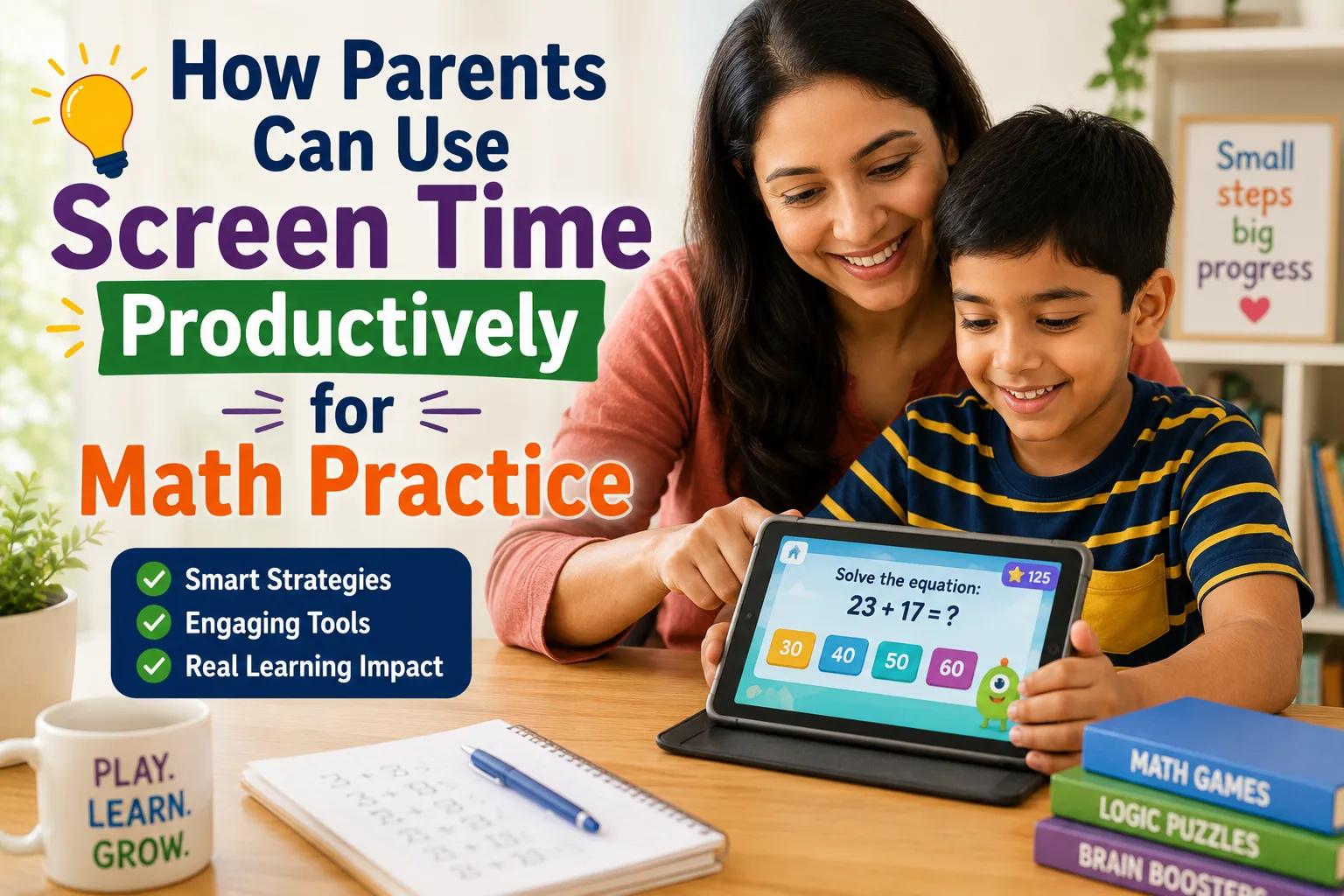
As both a software developer and a math educator, parents often ask me for advice on managing screen time. They feel guilty when their children spend time on tablets or computers, worrying that it is rotting their brains or distracting them from "real" learning.
My advice usually surprises them: don't ban screens; change what's on them.
Screen time is not inherently bad. The real issue is the quality of the content. There is a massive difference between mindlessly watching autoplay videos and actively engaging with a logic puzzle or an educational game.
If guided correctly, screen time can become a powerful, interactive tool for math practice. Here is how parents can transform passive screen time into productive, active math learning.
1. Choose "Active" Over "Passive" Games
Not all educational apps are created equal. Many "math games" are simply digital flashcards—solve a problem, get a point, and move on. These can quickly become boring.
- Active Games: Look for games that require spatial reasoning, strategy, and problem-solving.
- What to play: Games like Arrow Puzzle or grid-based paths require kids to plan steps, rotate shapes, and test logic. These games stimulate the prefrontal cortex and build problem-solving resilience, unlike simple multiple-choice quizzes.
2. Turn Screen Time Into Family Time
Screen time is often a solitary activity. A child sits alone with headphones, disconnected from the family.
- Cooperative Screen Time: You can change this dynamic by projecting games onto a TV or using a shared laptop.
- Family Play: Play a quick match of MathTug together. You can be the Red Team and your child can be the Blue Team, or you can work together to solve a high level of a puzzle. This turns a screen into a tool for family communication and bonding.
3. Limit the Time, Not the Learning
The American Academy of Pediatrics recommends setting clear boundaries on daily screen time, and I agree. However, the structure of the time matters.
- The "Math First" Rule: A great strategy is to set a "math-first" screen rule. For example, before your child can play their favorite entertainment game or watch a video, they must spend 15 minutes playing an educational math game.
- No Brain-Drain: This ensures their brain is active and primed before they transition to passive entertainment.
4. Ask Guided Questions
To maximize the learning benefits of screen time, talk to your child about the game they are playing.
- Engaging Questions: Ask: "Why did you make that move?", "What happens if you turn that arrow left instead of right?", or "Can you show me how you solved that level?"
- Metacognition: Asking children to explain their strategy helps develop metacognition—the ability to think about their own thinking process. It solidifies their logical reasoning.
5. Connect the Screen to the Real World
A common criticism of screen time is that it doesn't translate to real life. Parents can bridge this gap by connecting game concepts to physical activities.
- Real-World Links: If your child is playing a fraction game on the screen, bake cookies together over the weekend and let them measure out
1/2and1/4cups of flour. If they are playing a skip counting game, count coins or shoes around the house by 2s and 5s. - Anchoring Concepts: Connecting the digital experience with physical, real-world objects anchors the mathematical concepts in their minds.
Conclusion
Screen time is a tool. In the hands of a parent who guides the experience, it can be one of the most effective ways to make math practice engaging, collaborative, and fun. By choosing active logic puzzles, playing games like MathTug together, and asking guided questions, you can turn screen time into a premium educational asset. Try it tonight!
Recommended Hands-on Math & Focus Tools
Top-rated learning tools on Amazon that support the strategies in this article:

📥 Get Our Free Classroom Math Puzzles & Worksheets
Enjoyed this guide? Join our educator community and receive weekly printable activities and mental math worksheets.
About the Author: Shubham
Math Educator & Developer
Shubham is a dedicated math educator and software engineer with a passion for gamifying education. He created MathTug to help teachers and parents utilize interactive digital games on smartboards and projectors to make math learning collaborative, active, and stress-free for kids.
Learn more about our educational mission on the About Us page →Enjoyed this post?
Share it with your colleagues or explore more fun ways to teach math on MathTug.
🎮 Play Games