
Developing Spatial Reasoning: Fun Grid and Path Puzzles for Elementary Kids
Spatial reasoning is a key predictor of future STEM success. Discover why grid and path puzzles are essential tools for developing these skills in elementary children.
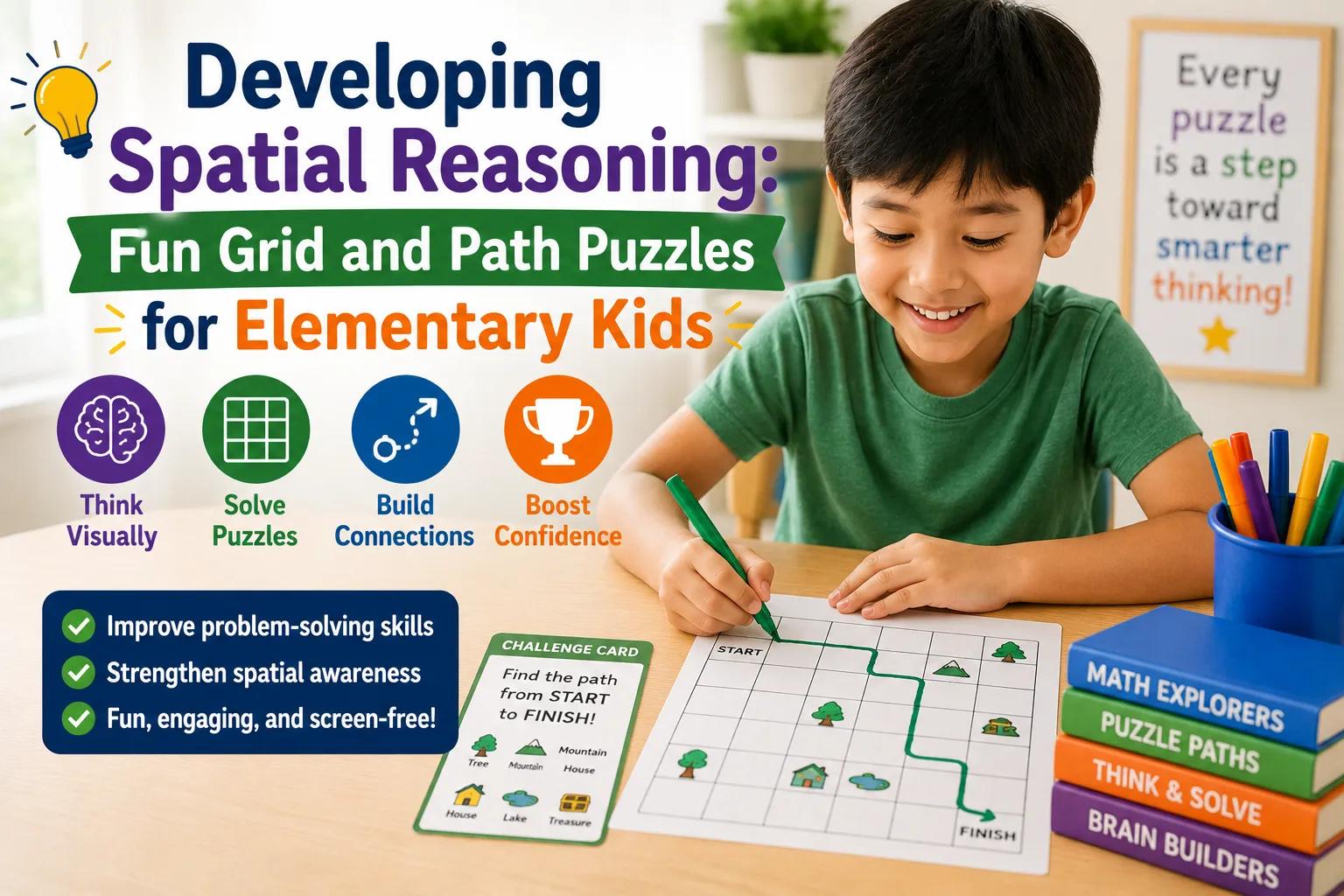
In my double role as a software developer and a math educator, I am constantly reminded of the importance of spatial skills. When I write code, I have to visualize structures. When I teach math, I have to help students visualize quantities.
Spatial reasoning—the ability to visualize and manipulate 2D and 3D shapes in your mind—is often overlooked in standard school curricula.
Yet, educational research has shown that early spatial skills are a stronger predictor of future success in STEM (Science, Technology, Engineering, and Math) fields than early reading or arithmetic scores.
Fortunately, spatial reasoning is not a fixed talent. It is a muscle that can be trained and strengthened.
One of the best ways to develop this muscle in elementary kids is through grid and path puzzles. Let's look at why these puzzles are so effective and how you can use them at home or in the classroom.
What is a Path and Grid Puzzle?
Path and grid puzzles are games where players must navigate a grid-based board under specific constraints. Examples include:
- Number Paths: Connecting numbers in a specific sequence to draw a line through a maze.
- Arrow Puzzles: Placing arrows on a grid to guide a line through every empty block on the board.
- Minesweeper Grids: Using numerical clues to deduce the locations of obstacles on a grid.
How Grid Puzzles Build Spatial Reasoning
1. They Train Mental Rotation and Transformation
Before a child places a piece or draws a line on a grid, they must perform the action in their mind first.
- The Cognitive Process: A student looks at an empty space and thinks: "If I turn this arrow right, where will the line go?" They are mentally rotating the direction and predicting the physical path.
- Why it matters: This ability to rotate objects mentally is the exact same skill used by architects designing buildings, surgeons performing procedures, and students learning 3D coordinate geometry.
2. They Teach "Look-Ahead" Planning
Grid puzzles cannot be solved by random guessing. They require forward planning.
- The Cognitive Process: To solve a path puzzle, a child must think multiple steps ahead: "Step A leads to Step B, but Step B will trap me in the corner. So, Step A must be wrong."
- Why it matters: This teaches executive functioning and working memory. It helps kids learn how to plan, check their work, and adjust their strategy before making a move.
3 Path and Grid Games to Play
1. MathTug Arrow Puzzle (Digital Path Game)
- Best for: Multi-step planning and spatial logic (Grades 1-8)
On our website, we created Arrow Puzzle specifically to target this skill.
- How it works: Players are given a grid with empty blocks and a set of directional arrows. They must arrange the arrows so that a single, continuous line traverses through every block without crossing itself.
- Why I recommend it: The drag-and-drop interface makes it highly interactive, allowing kids to test their spatial theories instantly.
2. The Tape Floor Maze (Physical Path Game)
- Best for: Younger learners (Kindergarten to Grade 2)
Bring the grid puzzle to life on a giant scale.
- How to play: Use painter's tape to create a grid on the floor. Place obstacles (like plastic cones or stuffed animals) in certain squares. Give the student a list of "coding commands" (e.g., Forward 2, Turn Right, Forward 1) to navigate from start to finish.
- Why I recommend it: It connects bodily movement (kinesthetic learning) with spatial grid math, which is perfect for younger kids.
3. Number Path Connect (Paper or Whiteboard)
- Best for: Connecting arithmetic with spatial lines (Grades 1-4)
This is a simple grid puzzle you can draw on a whiteboard in two minutes.
- How to play: Draw a grid with numbers scattered inside. The goal is to draw a continuous path that connects the numbers in order (e.g.,
1 to 2 to 3 to 4...) without ever crossing the line or stepping on the same square twice. - Why I recommend it: It turns basic number sequence practice into a spatial puzzle challenge.
Conclusion
Spatial reasoning is the silent engine behind mathematical and scientific understanding. By replacing standard worksheets with interactive grid paths, tape mazes, and digital logic games like Arrow Puzzle, you can help your students build a powerful spatial brain. Try introducing a grid puzzle to your child today!
Recommended Hands-on Math & Focus Tools
Top-rated learning tools on Amazon that support the strategies in this article:
📥 Get Our Free Classroom Math Puzzles & Worksheets
Enjoyed this guide? Join our educator community and receive weekly printable activities and mental math worksheets.
About the Author: Shubham
Math Educator & Developer
Shubham is a dedicated math educator and software engineer with a passion for gamifying education. He created MathTug to help teachers and parents utilize interactive digital games on smartboards and projectors to make math learning collaborative, active, and stress-free for kids.
Learn more about our educational mission on the About Us page →Enjoyed this post?
Share it with your colleagues or explore more fun ways to teach math on MathTug.
🎮 Play Games