
Beyond Rote Memorization: How to Build Conceptual Math Fluency
Memorizing math facts is not enough. Discover why conceptual fluency is key to long-term math success and how to build it using visual and interactive strategies.
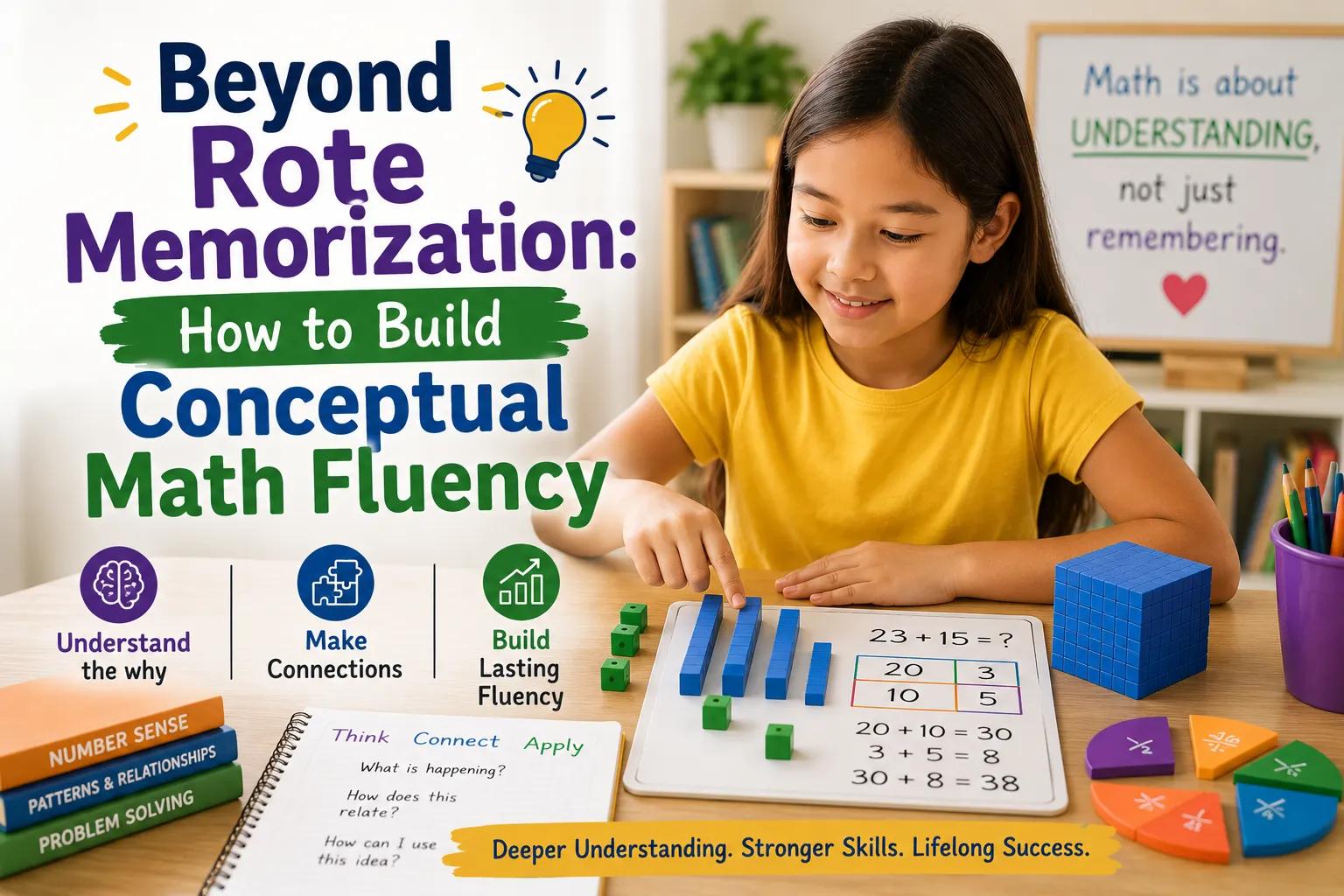
In my career as a math educator, I often meet students who can recite their multiplication tables from memory in seconds. Yet, when handed a simple word problem that requires them to apply that multiplication, they get stuck.
They ask: "Do I add or multiply here?"
This is the classic symptom of rote memorization without conceptual understanding.
While memorization has its place, it is not the same as math fluency. True mathematical fluency is the ability to solve problems accurately, efficiently, and flexibly.
If a student only memorizes "tricks," their math progress will hit a wall when they reach higher-level algebra and calculus. Here is why we must teach beyond rote memorization and how to build true conceptual math fluency.
What is Conceptual Fluency?
Conceptual fluency means understanding why a mathematical procedure works. It is the difference between:
- Rote Memorization: Memorizing that
8 x 7 = 56. - Conceptual Fluency: Knowing that
8 x 7is eight groups of seven, or that it is the same as(8 x 5) + (8 x 2), which is40 + 16 = 56.
When a student has conceptual fluency, they have a safety net. If they forget the fact 8 x 7 under test pressure, they can use their understanding of number relationships to calculate it quickly in their head.
4 Strategies to Build Conceptual Fluency
1. Use Concrete, Pictorial, and Abstract (CPA) Models
This is the gold standard of math instruction.
- Concrete: Let kids touch physical objects (like counting blocks or coins).
- Pictorial: Draw pictures, bars, arrays, or number lines to represent the math.
- Abstract: Write the numbers and symbols (
+,-,x,/). - Tip: Never jump straight to the abstract symbols. Always let students spend time with concrete and pictorial models first.
2. Play Games That Visualize Number Relationships
Games are a fantastic way to practice number relationships dynamically.
- How to use it: In games like MathTug, equations are paired with visual targets. When students see a problem, they aren't just looking at dry text; they are engaging with visual quantities and team progress.
- Why it works: It helps students build a mental representation of numbers, which is the foundation of estimation and number sense.
3. Encourage "Number Talks"
A number talk is a short classroom discussion where students explain their mental strategies for solving a math problem.
- How it works: Write a problem like
18 x 5on the board. Ask students to solve it in their heads and then explain their method.- Student A: "I did 10 x 5 = 50 and 8 x 5 = 40, then 50 + 40 = 90."
- Student B: "I knew that 20 x 5 = 100, so I subtracted 2 x 5 = 10 to get 90."
- Student C: "I doubled 5 to get 10, halved 18 to get 9, and did 9 x 10 = 90."
- Why it works: It shows students that there are multiple valid paths to an answer, which builds number flexibility.
4. Focus on "Decomposing" Numbers
Decomposing is the practice of breaking numbers down into smaller, friendlier parts.
- How it works: Teach students how to break numbers apart. For example, instead of memorizing
7 + 8, they can break 8 into3 + 5. Then, combine the 3 with 7 to make a friendly 10, leaving10 + 5 = 15. - Why it works: Making a 10 is a foundational skill that makes double-digit addition and subtraction much easier.
Conclusion
True math fluency is built when we prioritize understanding over speed. By using visual models, encouraging number talks, and using interactive tools like MathTug, we can help our students see the relationships between numbers. When kids understand the "why" behind the math, the "how" becomes natural. Let's teach for understanding!
Recommended Hands-on Math & Focus Tools
Top-rated learning tools on Amazon that support the strategies in this article:


📥 Get Our Free Classroom Math Puzzles & Worksheets
Enjoyed this guide? Join our educator community and receive weekly printable activities and mental math worksheets.
About the Author: Shubham
Math Educator & Developer
Shubham is a dedicated math educator and software engineer with a passion for gamifying education. He created MathTug to help teachers and parents utilize interactive digital games on smartboards and projectors to make math learning collaborative, active, and stress-free for kids.
Learn more about our educational mission on the About Us page →Enjoyed this post?
Share it with your colleagues or explore more fun ways to teach math on MathTug.
🎮 Play Games