
5 Everyday Activities That Build Strong Mental Math Skills in Kids
Mental math is a crucial life skill. Discover five simple, everyday activities parents can do with their kids to build strong mental calculation skills without using worksheets.
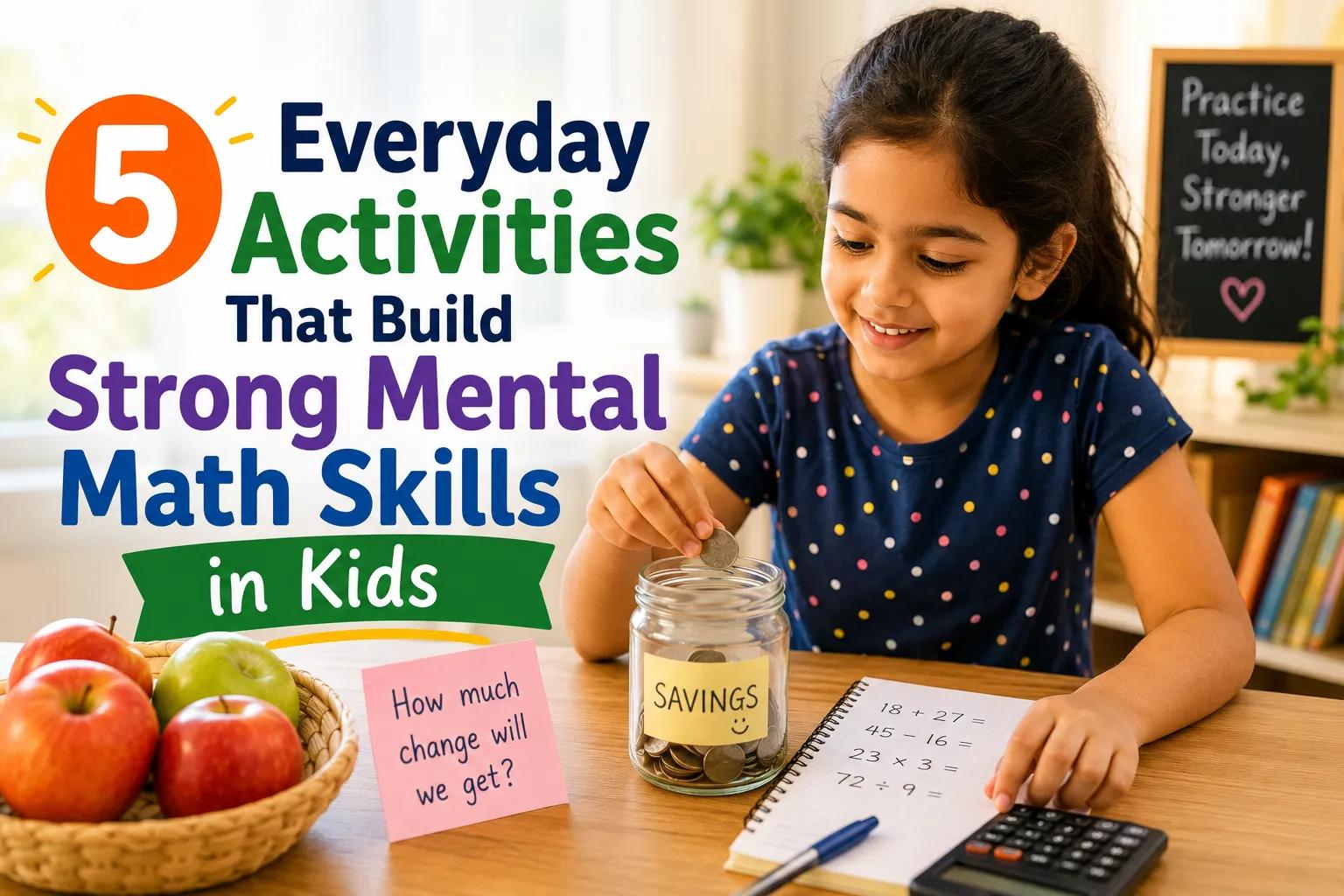
As an educator, I always tell parents that math is not just a classroom subject—it is all around us. Some of the most valuable math lessons don't happen at a desk; they happen in the grocery store, in the kitchen, or during a car ride.
Mental math—the ability to perform mathematical calculations in your head—is a crucial life skill. It builds number sense, estimation abilities, and logical reasoning.
However, we don't need worksheets or drills to teach it.
By sneaking math into your daily routine, you can help your child build strong mental math skills while showing them that math is a practical, useful tool for real life. Here are five simple, everyday activities that build mental math fluency.
1. The Grocery Store Estimate
- Best for: Addition, multiplication, and estimation (Grades 2-6)
The grocery store is a giant math playground. It is the perfect place to practice addition and estimation in a real-world setting.
- How to play: Give your child a target budget (for example, **20∗∗).Asyouplaceitemsinyourcart,havethemkeeparunningtotalintheirheadbyroundingthepricestothenearestdollar.Ifyoubuyitemsfor20∗∗).Asyouplaceitemsinyourcart,havethemkeeparunningtotalintheirheadbyroundingthepricestothenearestdollar.Ifyoubuyitemsfor3.89, 1.15,and1.15,and5.50, they should estimate:
4 + 1 + 6 = 11. - Why I recommend it: It teaches "estimation," which is a highly important math skill. It shows kids how math helps us make financial decisions in real time.
2. Kitchen Measurement (Baking Math)
- Best for: Fractions, doubling, and halving (Grades 1-5)
Baking is pure mathematics. Measuring cups and spoons are excellent physical models for fractions.
- How to play: When baking cookies or bread, ask your child to do the math: "This recipe calls for 1/2 cup of sugar, but we want to double the recipe. How much sugar do we need?" or "We only have a 1/4 measuring cup. How many of these do we need to make 1/2 cup?"
- Why I recommend it: It makes fractional values tangible. Seeing and filling two
1/4cups of flour to equal a1/2cup makes the concept of equivalent fractions clear and memorable.
3. The License Plate Game (Car Ride Math)
- Best for: Addition, mental speed, and pattern recognition (Grades K-8)
Long car rides can be boring, making them the perfect opportunity for quick mental math games.
- How to play: Have everyone look at the license plate of the car in front of you.
- For younger kids: Ask them to add all the digits together.
- For older kids: Challenge them to make the number 24 using the digits on the plate and any mathematical operation (+, -, x, /).
- Why I recommend it: It requires no props and turns a boring commute into a fast-paced game that builds number flexibility.
4. Telling Time and Calculating Intervals
- Best for: Addition, subtraction, and time intervals (Grades 1-5)
Learning to read clocks and calculate intervals is a challenge for many kids, but everyday routines make it easy to practice.
- How to play: Ask your child to calculate time throughout the day: "It is 4:15 PM right now. Dinner is at 5:00 PM. How many minutes do we have until dinner?" or "The movie is 90 minutes long. If it starts at 2:00 PM, what time will it end?"
- Why I recommend it: It connects math to their personal schedule, making the calculation highly relevant and motivating for them to solve.
5. Board Games and Card Games
- Best for: Addition, subtraction, strategy, and probability (Grades K-6)
Family game nights are excellent for natural math practice.
- How to play: Play games that involve counting and money, like Monopoly Junior, Yahtzee, or card games like Uno and War. Let your child be the "banker" or the scorekeeper.
- Why I recommend it: It puts the child in charge of the calculations, which builds confidence and shows them that math is a natural part of play.
Conclusion
Mental math is a muscle that grows stronger with daily exercise. By integrating these simple activities into your family's routine—alongside fun digital games like MathTug—you can help your child develop strong calculation speed and confidence. Show them that math is all around us, and watch their skills soar!
Recommended Hands-on Math & Focus Tools
Top-rated learning tools on Amazon that support the strategies in this article:
📥 Get Our Free Classroom Math Puzzles & Worksheets
Enjoyed this guide? Join our educator community and receive weekly printable activities and mental math worksheets.
About the Author: Shubham
Math Educator & Developer
Shubham is a dedicated math educator and software engineer with a passion for gamifying education. He created MathTug to help teachers and parents utilize interactive digital games on smartboards and projectors to make math learning collaborative, active, and stress-free for kids.
Learn more about our educational mission on the About Us page →Enjoyed this post?
Share it with your colleagues or explore more fun ways to teach math on MathTug.
🎮 Play Games