
Multiplication Tug of War: How 2-Player Battles Build Rapid Fact Recall
Why do students master times tables 3x faster when playing Multiplication Tug of War? Discover the cognitive science behind competitive math gamification.
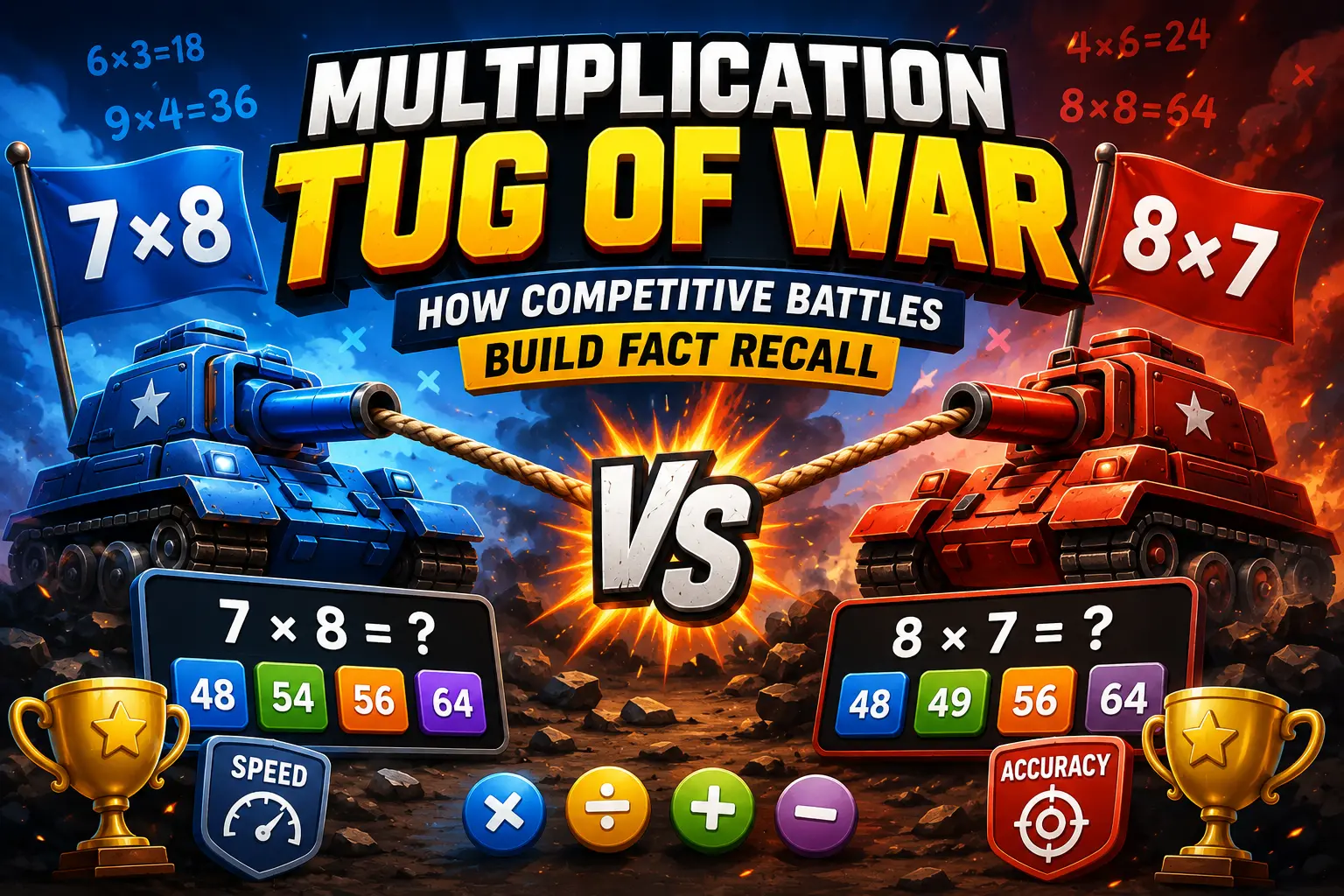
The Battle Against Times Table Monotony: Memorizing the 144 facts of the 12×12 multiplication grid has traditionally been one of the driest parts of elementary school. When students are subjected to silent timed worksheets (like "Mad Minute" drills), anxiety often spikes while long-term retention remains low.
Enter Multiplication Tug of War — an interactive 2-player browser game on MathTug that transforms times table practice into a thrilling, high-energy virtual tug-of-war match. In this article, we explore the cognitive science of why gamified peer competition builds automaticity faster than conventional methods, and how teachers can implement it in their classrooms.
How Multiplication Tug of War Works
🎮 The Core Game Loop:
- Two Opponents, One Screen: Player 1 (Red) and Player 2 (Blue) share a single Chromebook, laptop, or smartboard.
- Live Multiplication Clashes: A multiplication problem appears (e.g.,
8 × 7 = ?). Both players quickly calculate the product mentally. - The Tug Mechanism: The first player to enter the correct answer (
56) pulls the virtual rope one notch toward their home base. - Penalty for Guessing: Inaccurate answers trigger a 1.5-second cooldown penalty, preventing mindless spamming and rewarding accuracy over wild guessing.
- The Victory Pull: The first player to pull the center flag past the win line wins the match!
The Cognitive Science: Why Peer Battles Build Automatic Recall
1. High-Arousal Dopamine Engagement
When two students compete side-by-side, the brain releases dopamine and norepinephrine. This heightened state of alert attention accelerates synaptic plasticity — the neurological process of converting short-term calculation into permanent long-term memory retrieval.
2. Elimination of Negative Math Anxiety
Unlike solitary testing where students feel judged by an authority figure, peer games frame mistakes as temporary gameplay setbacks rather than personal failures. Kids laugh, hit "Rematch," and immediately re-engage.
3. Instant Feedback Loops
Traditional worksheets provide feedback hours or days after completion, when the learning moment has passed. In Multiplication Tug of War, feedback is instantaneous: students immediately see the correct solution the moment a round concludes.
👉 Play Multiplication Tug of War Now →
Want more two-player classroom games? Check out our list of 12 Interactive 2-Player Math Games and visit the 2-Player Hub.
Times Table Progression Guide (Grades 2 to 6)
| Grade Tier | Recommended Times Tables | Key Focus Areas |
|---|---|---|
| Grade 2 / Early 3rd | 2s, 5s, and 10s Tables | Pattern recognition, skip counting connections, and parity rules. |
| Grade 3 Core | 3s, 4s, and 6s Tables | Doubling strategies (4x is double 2x; 6x is double 3x). |
| Grade 4 Fluency | 7s, 8s, 9s, and 12s Tables | The "Tricky Fact Cluster" — 7 × 8, 6 × 7, 9 × 8, 12 × 12. |
| Grade 5+ Mastery | Mixed 0–12 Random Blitz | Sub-2-second instant automatic recall across all 144 facts. |
Teacher Guide: Organizing a 10-Minute Classroom "Tug Tournament"
- Pair Evenly: Group students with similar baseline calculation speeds to ensure nail-biting matches that keep both sides motivated.
- Display on Smartboard: Cast a feature match between two student finalists on the main classroom smartboard while the rest of the class calculates along on mini dry-erase boards.
- Track Weekly Fact Champions: Reward students who show the greatest improvement in their tug-of-war win rates, emphasizing growth over starting ability.
Frequently Asked Questions
Is Multiplication Tug of War completely free to play?
Yes. Math Tug of War is 100% free to play directly in your web browser with no sign-up, no student tracking, and no subscriptions.
Can students play at home on phones or tablets?
Yes! The game features a fully responsive touch-enabled design so siblings or parents and children can play 2-player battles on any tablet or smartphone.
Recommended Hands-on Math & Focus Tools
Top-rated learning tools on Amazon that support the strategies in this article:
📥 Get Our Free Classroom Math Puzzles & Worksheets
Enjoyed this guide? Join our educator community and receive weekly printable activities and mental math worksheets.
About the Author: Shubham
Math Educator & Developer
Shubham is a dedicated math educator and software engineer with a passion for gamifying education. He created MathTug to help teachers and parents utilize interactive digital games on smartboards and projectors to make math learning collaborative, active, and stress-free for kids.
Learn more about our educational mission on the About Us page →Enjoyed this post?
Share it with your colleagues or explore more fun ways to teach math on MathTug.
🎮 Play Games