5-Minute Math Warm-Ups: Engaging Games for the Start of Class
Discover quick, low-prep interactive math warm-ups and games that will grab your students' attention and activate their brains in the first five minutes of class.
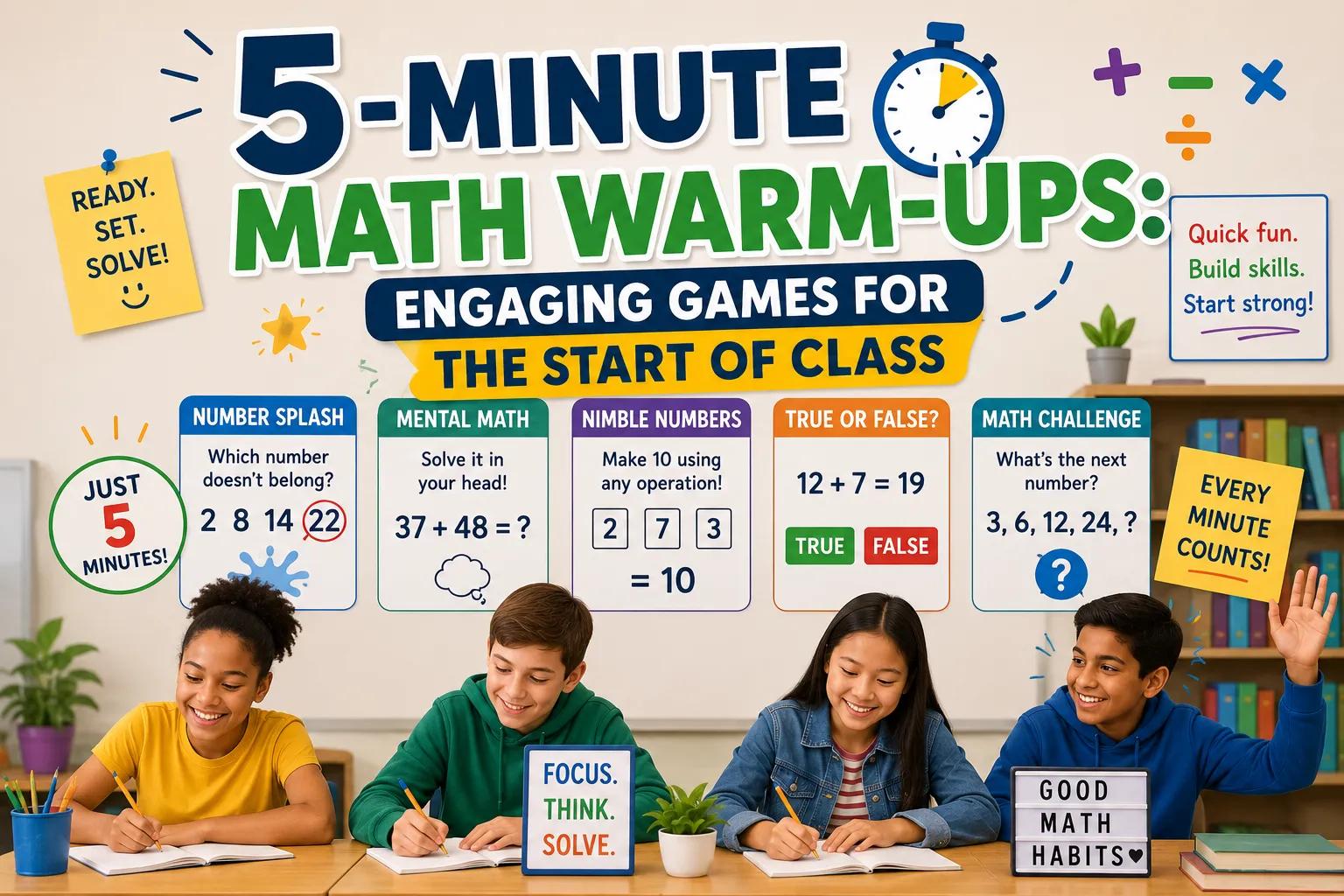
Introduction The first five minutes of math class set the tone for the entire lesson. If students walk in and are immediately handed a dry worksheet, their engagement drops before the lesson even begins. On the other hand, starting with a quick, low-stakes game can energize the room, transition their focus from recess, and prime their brains for mathematical thinking.
A good math warm-up should be fast, highly engaging, and require minimal prep. Here are five simple 5-minute math warm-up games that teachers can use to start every class with excitement.
1. The Daily Tug (Virtual Math Tug-of-War)
- Best for: Activating basic arithmetic fluency (Grades K-8)
Using a quick interactive game on the classroom screen is one of the fastest ways to get everyone looking at the front of the room.
- How to play: Open a quick match of MathTug on your projector. Have two students represent the teams at the board, or let the left side of the class compete against the right side. Run a single 3-minute round of addition, subtraction, or multiplication.
- Why it works: It requires zero preparation from the teacher and immediately captures the focus of every student in the room.
2. Number of the Day
- Best for: Number sense and operations practice (Grades 1-6)
This classic warm-up is highly adaptable and can be scaled in difficulty depending on the grade level.
- How to play: Write a single number in the center of the whiteboard (e.g., 24). Give students two minutes to write down as many mathematical expressions as they can that equal that number.
- Example expressions:
12 + 12,48 / 2,(3 x 10) - 6, orsquare root of 576.
- Example expressions:
- Why it works: It is an open-ended activity where struggling students can write simple expressions (like
20 + 4), while advanced students can challenge themselves with complex formulas.
3. "I Have, Who Has?" Chain Game
- Best for: Listening skills and mental math recall (Grades 2-8)
This is a fast-paced card game that involves the whole class listening and responding to math equations.
- How to play: Distribute "I Have, Who Has?" cards to the class. A student starts by reading their card: "I have 12. Who has 4 times 5?" The student holding the card that says "I have 20" must reply: "I have 20. Who has 15 minus 7?" The game continues in a chain until it loops back to the first student.
- Why it works: It forces students to perform mental math calculations quickly and pay close attention to their peers.
4. True or False Blitz
- Best for: Spotting common math misconceptions (Grades K-8)
Developing critical thinking skills involves learning how to spot mistakes and justify mathematical reasoning.
- How to play: Project a math equation on the smartboard that contains a common mistake (e.g.,
2 + 3 x 5 = 25— which forgets the order of operations). Ask students to give a thumbs up for true or a thumbs down for false. Have one student explain why the statement is false and how to correct it. - Why it works: It teaches students that mistakes are valuable learning tools and helps correct common mathematical misconceptions before the main lesson starts.
5. Mystery Number Path
- Best for: Logical reasoning and grid math (Grades K-5)
This game works by presenting a grid or path with missing numbers, requiring students to find the missing links using logic.
- How to play: Project a grid puzzle on the board (like a skip-counting grid or a simple number maze). Let students raise hands to fill in the missing numbers to unlock the path.
- Why it works: It feels like a video game puzzle, making it highly engaging for young students who enjoy solving mysteries.
Best Practices for Math Warm-Ups
To make your 5-minute warm-ups successful, keep these three guidelines in mind:
- Keep it Low-Stakes: Do not grade warm-ups. They are meant to be fun, safe opportunities for students to try, fail, and learn without pressure.
- Be Consistent: Use warm-ups daily so students build a routine. They will walk into the classroom knowing exactly what to expect.
- Encourage Participation: Use hand signals (like thumbs up/down) or dry-erase lapboards so that every student is actively participating, not just the ones who raise their hands first.
Conclusion
A great math warm-up acts like a stretching exercise for the brain. By dedicating the first five minutes of your class to these interactive games, you can transform how your students perceive math—making it a subject of exploration, play, and joy.
Recommended Hands-on Math & Focus Tools
Top-rated learning tools on Amazon that support the strategies in this article:


📥 Get Our Free Classroom Math Puzzles & Worksheets
Enjoyed this guide? Join our educator community and receive weekly printable activities and mental math worksheets.
About the Author: Shubham
Math Educator & Developer
Shubham is a dedicated math educator and software engineer with a passion for gamifying education. He created MathTug to help teachers and parents utilize interactive digital games on smartboards and projectors to make math learning collaborative, active, and stress-free for kids.
Learn more about our educational mission on the About Us page →Enjoyed this post?
Share it with your colleagues or explore more fun ways to teach math on MathTug.
🎮 Play Games