
12 Interactive 2-Player Math Games to Play in Classrooms & Smartboards
Transform your classroom into an energetic learning arena with these 12 interactive two-player math battle games designed for single laptops, tablets, and smartboards.
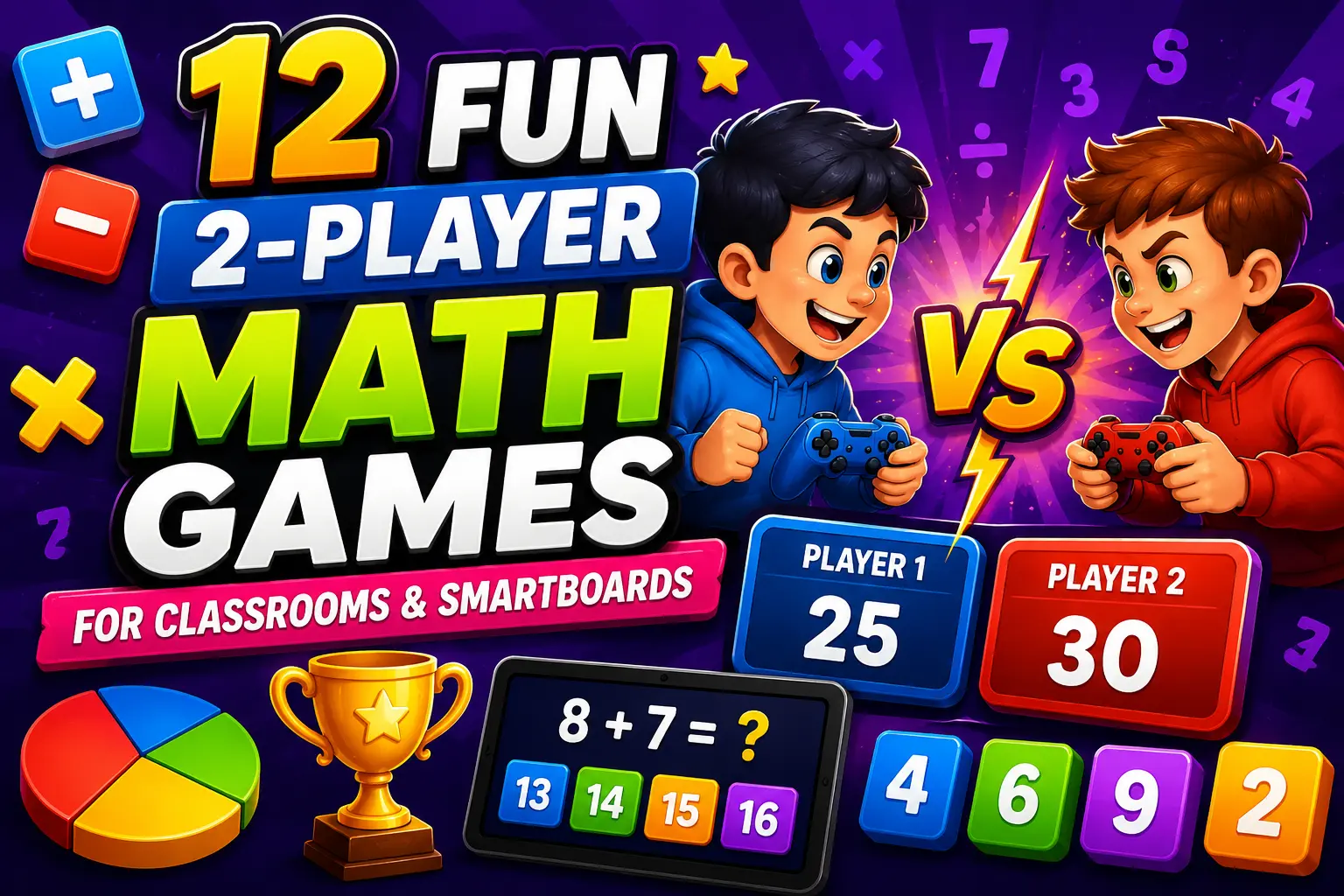
Why 2-Player Math Battles Transform Math Fluency: When students practice math alone on generic worksheets, their minds frequently wander. But when you put two students side-by-side in a friendly, high-stakes 2-player math duel on a single Chromebook or classroom smartboard, calculation speed and engagement skyrocket instantly.
Peer competition creates a natural adrenaline rush that turns basic arithmetic drills into an exciting game of strategy. Here are the 12 best interactive two-player math games designed specifically for classroom laptops, touchscreens, and interactive whiteboards.
Classroom Pairing Cheat-Sheet: Top 2-Player Math Duels
| Game | Math Focus | Device Setup | Recommended Grade |
|---|---|---|---|
| Math Tug of War | Speed Arithmetic (+, -, ×, ÷) | Shared Keyboard / Smartboard | Grades K–8 |
| Balance Scale Duel | Pre-Algebra & Mass Estimation | Touchscreen / Mouse | Grades 2–6 |
| Greater vs. Less Battle | Number Comparison & Inequalities | Split Screen | Grades K–4 |
| Memory Match Duel | Equation & Product Pairing | Turn-Based (1 Screen) | Grades 1–5 |
| Odd or Even Faceoff | Fast Number Property Sorting | Split Keyboard (W vs Up) | Grades K–3 |
| Skip Count Race | Pattern Sequences (2s, 5s, 10s) | 1v1 Split Screen | Grades 1–4 |
1. MathTug: Math Tug of War (The Ultimate 2-Player Showdown)
- How It Plays: Red Team vs. Blue Team. A large rope sits in the center of the screen with a marker flag. When a math question appears, both players must calculate the answer mentally and strike their designated answer keys.
- The Mechanic: Speed matters, but accuracy rules. A correct answer pulls the flag towards your side. An incorrect answer locks your player out for 1.5 seconds, giving your opponent a free pull.
- Classroom Setup: On a Chromebook, Player 1 sits on the left using
A/S/Dand Player 2 sits on the right usingJ/K/Lor arrows. On an interactive whiteboard, two students stand at opposite sides of the board tapping their options.
👉 Play 2-Player Math Tug of War Now →
2. Greater vs. Less Battle
- Skills: Rapid inequality evaluation (
>,<,=), fractions vs. decimals comparison. - How It Plays: Two numbers or math expressions drop onto opposite plates. Players slam their buzzer to claim which expression has the greater magnitude. First accurate claim scores points toward the victory bar.
👉 Play Greater vs Less Battle →
3. Balance Scale Pre-Algebra Battle
- Skills: Missing variables, visual equation balancing, and inverse operations.
- How It Plays: A virtual seesaw scale holds weights and unknown block variables. Both players race against the clock to place counterweights that bring the beam to a perfect horizontal level.
👉 Play Balance Scale Math Duel →
4. Memory Match Math Duel
- Skills: Working memory, spatial recall, and multiplication fact families.
- How It Plays: A turn-based faceoff on a 16-card grid. Player 1 flips a tile showing
6 × 7; they must remember where the42tile was previously revealed. Finding a correct pair awards an extra turn.
5. Skip Count Duel
- Skills: Number sequence mastery (2s, 3s, 5s, 10s, 25s), foundation for times tables.
- How It Plays: Two racecars advance across a split-screen raceway each time a player fills in the correct missing number along the track.
👉 Play Skip Count 2-Player Race →
6. Equation Builder Faceoff
- Skills: Multi-step arithmetic, order of operations, and mental agility.
- How It Plays: Both players receive the same target number (e.g.,
24) and a pool of 5 numbers. The first player to arrange an equation using+,-,×, or÷that evaluates to the target scores the round.
👉 Play Equation Builder Battle →
7. Math Grid 1v1 (Mini Sudoku Showdown)
- Skills: Deductive logic, non-repeating number placement.
- How It Plays: Players take turns placing numbers in a 4×4 or 6×6 mini sudoku grid. Completing a correct row or quadrant grants bonus points, while placing an illegal duplicate incurs a penalty.
8. Fraction Frenzy 2-Player Split
- Skills: Visualizing fraction equivalence, comparing unlike denominators.
- How It Plays: Fraction pizzas appear on screen. Players quickly identify which fractional portion is larger before the timer expires.
9. Number Sort Sprint
- Skills: Ascending and descending numerical order, decimals, negative integers.
- How It Plays: Five unordered numbers appear on each player's half of the screen. Players drag and drop them in order from least to greatest in a rapid physical race.
10. Prime Patrol 1v1
- Skills: Fast identification of prime and composite numbers.
- How It Plays: Stream of flying numbers passes across the screen. Players must shoot down only the prime numbers while avoiding composite traps.
11. Math Word Hunt Duel
- Skills: Mathematical vocabulary, geometric terms, arithmetic concepts.
- How It Plays: A shared letter grid where two students race simultaneously to trace math vocabulary words hidden horizontally, vertically, and diagonally.
12. Odd or Even Blitz Duel
- Skills: Number properties, rapid classification, zero mental friction.
- How It Plays: Ideal for younger students (Grades K–2), players rapidly swipe numbers left (Even) or right (Odd) to see who clears 20 numbers first.
Looking for more split-screen challenges? Explore our dedicated 2-Player Games Hub and Chromebook Classroom Portal.
How Teachers Can Organize Classroom 2-Player Tournaments
- The 5-Minute Bellringer Format: As soon as the bell rings, display a 2-player game link on the smartboard. Pair students with their desk partners for a quick best-of-three match.
- Equal Skill Matching: Pair students with similar calculation speeds so matches remain neck-and-neck, maintaining maximum motivation for both players.
- Smartboard Champion's Arena: Have two students play on the classroom interactive projector while the rest of the class cheers and calculates the solutions on mini whiteboards.
Frequently Asked Questions
Do these 2-player games require two separate devices?
No! The majority of games on MathTug are designed to work on a single Chromebook, PC, or iPad screen with split-keyboard bindings (left keys vs. right keys) or touch-screen taps, making them perfect for schools with limited 1:1 hardware.
Are these games free for classroom use?
Yes. All MathTug multiplayer games are 100% free with no subscription tiers, student paywalls, or login requirements.
Recommended Hands-on Math & Focus Tools
Top-rated learning tools on Amazon that support the strategies in this article:
📥 Get Our Free Classroom Math Puzzles & Worksheets
Enjoyed this guide? Join our educator community and receive weekly printable activities and mental math worksheets.
About the Author: Shubham
Math Educator & Developer
Shubham is a dedicated math educator and software engineer with a passion for gamifying education. He created MathTug to help teachers and parents utilize interactive digital games on smartboards and projectors to make math learning collaborative, active, and stress-free for kids.
Learn more about our educational mission on the About Us page →Enjoyed this post?
Share it with your colleagues or explore more fun ways to teach math on MathTug.
🎮 Play Games